

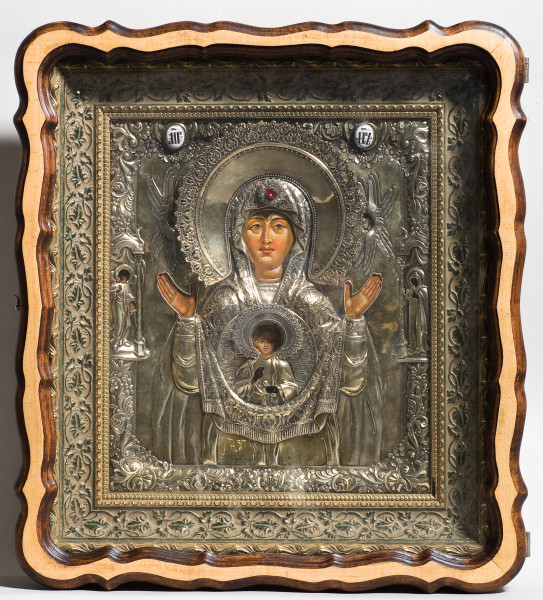


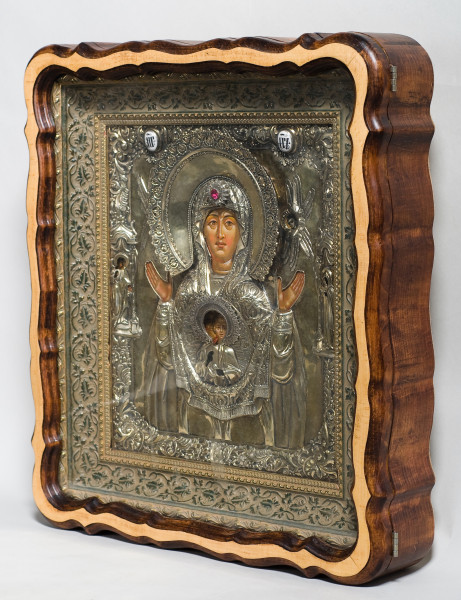
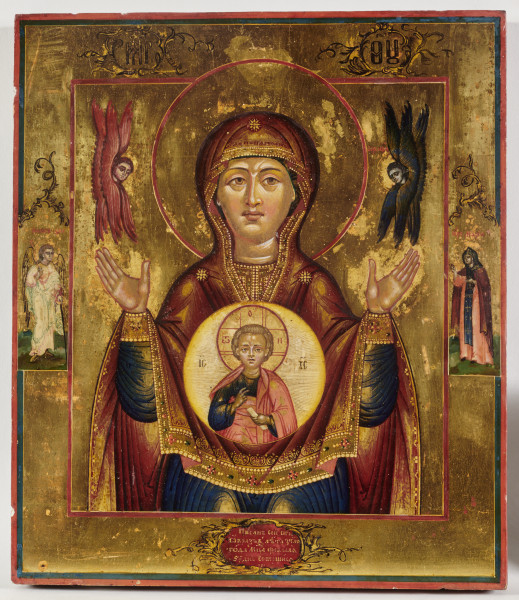

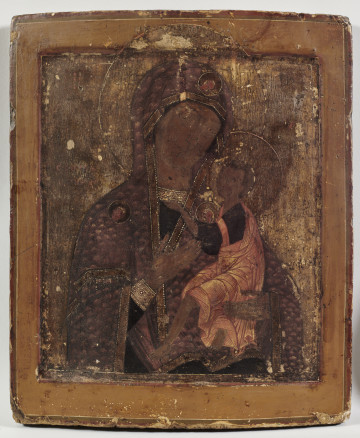
Mother of God Eleusa, Our August Mother
XIX century
Castle Museum in Łańcut
Part of the collection: Ikony
In Greek, Panagia means the holiest. This term had been used to describe the Mother of God in Eastern Christianity since ancient times. The name has also been adopted for her images, where Mary, depicted as an orante in a praying posture with her arms outstretched, has a locket with an image of the youthful blessing Christ Emmanuel placed on her bosom. Such a representation expresses the mystery of the Saviour's incarnation. In this way, the Mother of God becomes the gate and throne for Him. Christ's blessing gesture and dignified robe indicate the dignity of the supreme priest in His person. In the temple, the Mother of God Incarnate is pictured within the shrine vault which symbolises the earthly Church. In the Panagia image, the Mother of God, as the most important representative of the earthly Church, can be seen above the altar partition. In Russia, where elaborate iconostases covered the entire space between the shrine and nave, icons of the Mother of God Panagia began to be placed at the top of the altar partition below the Crucifixion icon. Her images were also popular in smaller icons.
Teresa Bagińska-Żurawska https://orcid.org/0000-0002-9243-3967
Author / creator
Object type
ikony
Technique
tempera, pozłotnictwo, metaloplastyka, stolarskie
Material
wood, chalk, distemper, gold, silver, ceramics, stone, glass
Creation time / dating
Creation / finding place
Owner
Muzeum - Zamek w Łańcucie
Identification number
Location / status
XIX century
Castle Museum in Łańcut
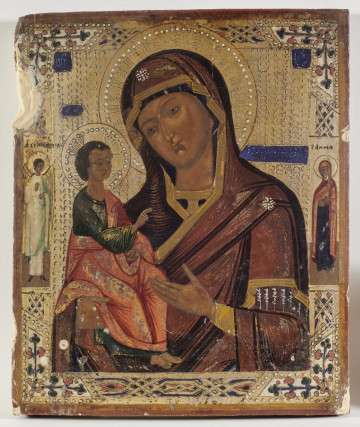
2nd half of the 19th century
Castle Museum in Łańcut
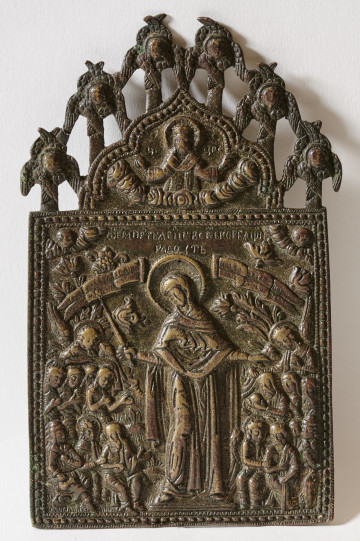
połowa XIX wieku
Castle Museum in Łańcut
DISCOVER this TOPIC
National Museum in Szczecin
DISCOVER this PATH
Educational path