

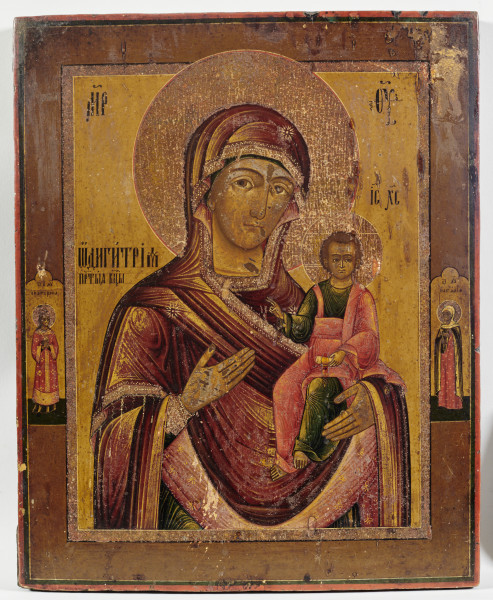


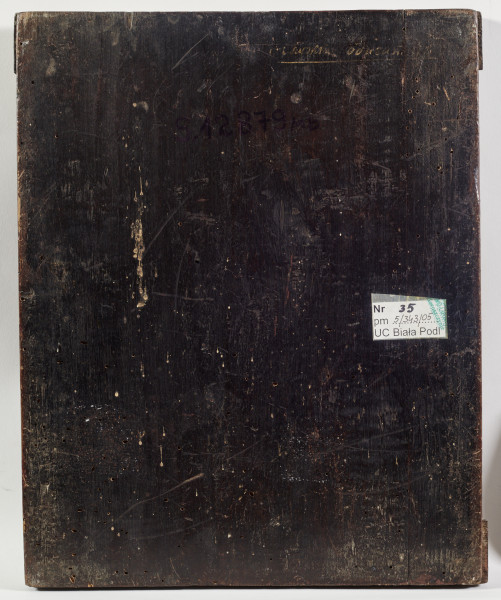
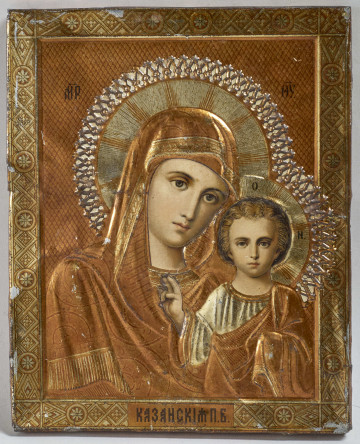
The Mother of God of Kazan, Hodegetria
koniec XIX w.
Castle Museum in Łańcut
Part of the collection: Ikony
The oldest image of the Mother of God Odigitria of Smolensk is believed to have been a copy of an icon from Constantinople brought to Ruthenia in 1046 and transferred from Chernigov to Smolensk in 1095. It became a testimony to the close ties linking the Rurikids dynasty with Byzantium. At the end of 14th century, the Principality of Smolensk became a dependency of the Grand Duchy of Lithuania. In 1398, prince Vytautas was said to have given the icon to his daughter Sophia who married the Prince of Moscow Vasily. According to another legend, the last Duke of Smolensk, fleeing from Prince Vytautas in 1404, took the icon to Moscow. In 1456, a copy was made for the Moscow Cathedral of the Annunciation of the Mother of God, and the original icon returned to Smolensk. Henceforth, the icon, perceived to be the protector of the western frontiers of Ruthenia, is called the icon of Smolensk. It enjoys enduring reverence among Russian Orthodox Christians. During Napoleon's expedition to Russia, the painting was taken to Yaroslavl on the Volga River. After the French troops retreated, it returned to Smolensk. A Moscow copy of the Smolensk icon of 1456 was secured in 1812 in Vologda. However, a copy of the image, which dates back to 1602 and was placed in the Gate Orthodox church of the Smolensk fortress, was taken away by the retreating Russian army from Smolensk. It was carried in religious processions and combat expeditions. Starting from the Battle of Borodino, it went through Europe with the Russian army, carried out as far as Paris, and later returned to Smolensk. Despite the persecutions of the Russian Orthodox Church after the 1917 Revolution, despite the destruction of equipment or the exclusion of many shrines from worship, all three oldest icons of the Smolensk Odigitria survived until the Second World War. The Germans who entered Smolensk in 1941 found the oldest one in the disused church of the Dormition of the Mother of God. Unfortunately, after they were driven out, the painting was no longer there and its disappearance remains a mystery to this day.
Teresa Bagińska-Żurawska https://orcid.org/0000-0002-9243-3967
Author / creator
Object type
ikony
Technique
tempera, pozłotnictwo
Material
wood, chalk, distemper, gold
Creation time / dating
Creation / finding place
Owner
Muzeum - Zamek w Łańcucie
Identification number
Location / status
koniec XIX w.
Castle Museum in Łańcut
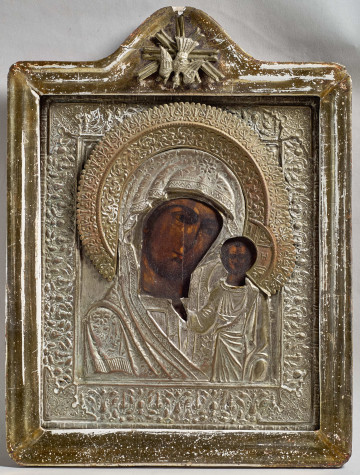
koniec XIX w.
Castle Museum in Łańcut
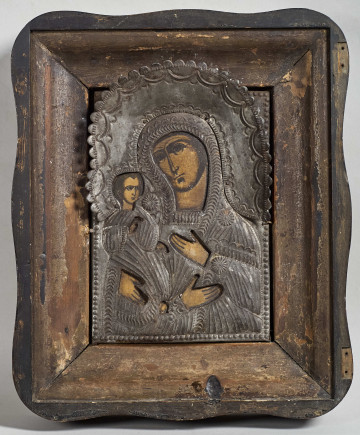
20th century
Castle Museum in Łańcut
DISCOVER this TOPIC
Castle Museum in Łańcut
DISCOVER this PATH
Educational path