

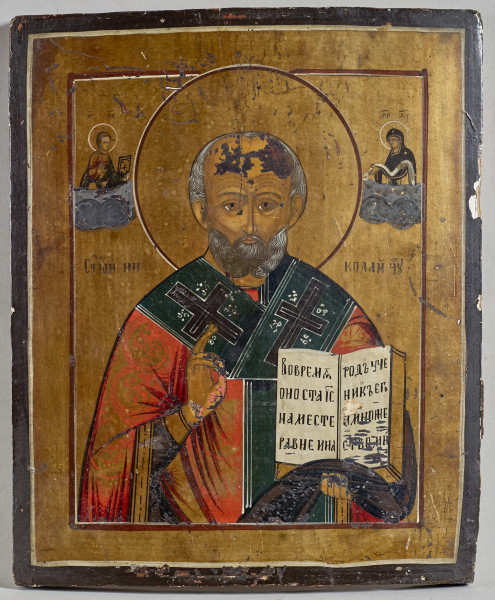


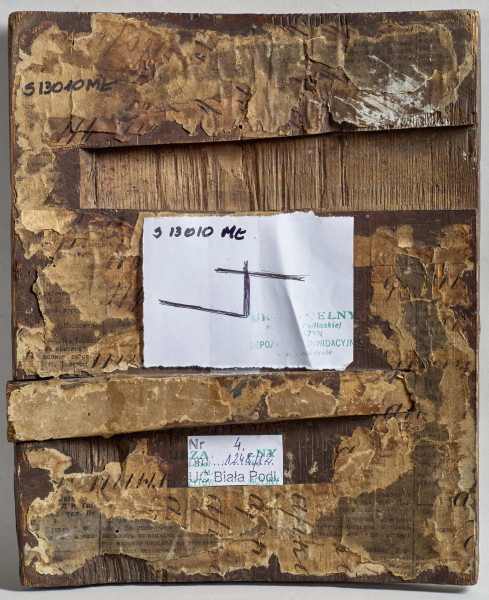
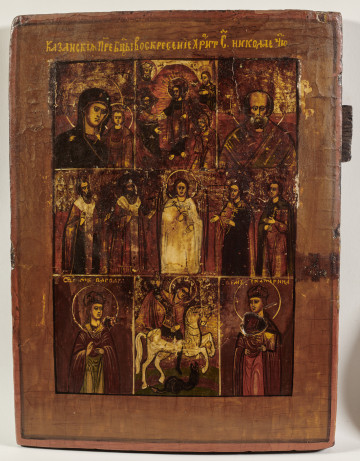
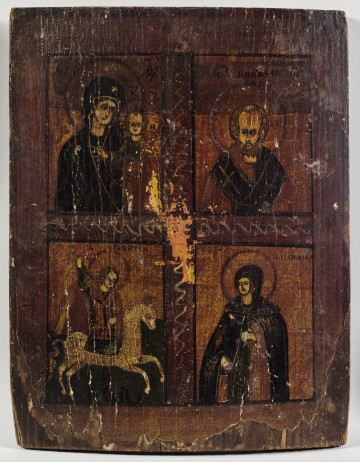
A multi-field icon, the Mother of God Odigitria of Kazan; the Resurrection of Christ; St. Nicholas, Archangel with saints; St. Barbara; St. George the Martyr, St. Catherine
2nd half of the 19th century
Castle Museum in Łańcut
Part of the collection: Ikony
Revered in both Eastern and Western Christianity, Nicholas the Wonderworker was the Archbishop of Myra in Asia Minor. He lived in the 3rd/4th century under Emperors Diocletian and Constantine the Great and became famous for many miracles. In Eastern Christianity, the cult of this saint developed as early as the fifth century and arrived in Ruthenia from Byzantium. Along with the cult, the oldest images of the saint appeared, and over the centuries many variants of his depiction have developed. On most icons, from as early as the 10th century, St Nicholas is accompanied by the figures of Christ and the Mother of God, who mark the saint for the office of bishop and offer him the insignia of the position he holds – the Gospel and the omophorion. Since the 14th century, the depictions of the Christ and the Mother of God on the icons of St Nicholas have been associated with a legend. St Nicholas the Wonderworker was said to have attended the First Council of Nicaea in 325, at which, according to the story, he was said to have slapped the heretic Arius. For this offence, St Nicholas was removed from his episcopal office. Thereupon Christ and the Mother of God appeared, restoring to the saint the status taken away as punishment. This legendary motif coexisted with other tales of St Nicholas' miracles, where the saint was recognised as the first benefactor in times of need, as evidenced by numerous paintings.
Teresa Bagińska-Żurawska https://orcid.org/0000-0002-9243-3967
Author / creator
Object type
ikony
Technique
tempera, pozłotnictwo
Material
wood, chalk, distemper, gold
Creation time / dating
Creation / finding place
Owner
Muzeum - Zamek w Łańcucie
Identification number
Location / status
2nd half of the 19th century
Castle Museum in Łańcut
XIX/XX wiek
Castle Museum in Łańcut
początek XX w.
Castle Museum in Łańcut
DISCOVER this TOPIC
Castle Museum in Łańcut
DISCOVER this PATH
Educational path