




Portrait of Prince Philip I
1541
National Museum in Szczecin
Part of the collection: English graphics
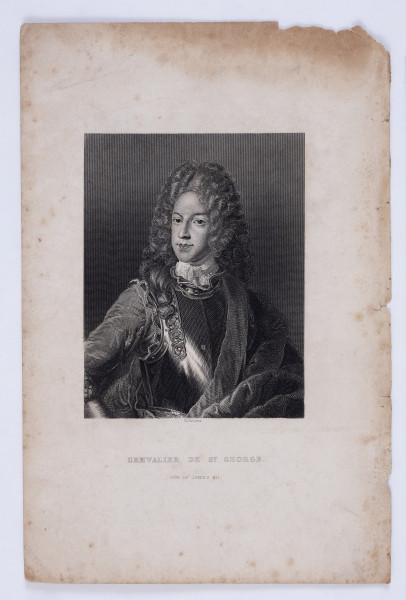
Chevalier de St. George, a contemplative young man in a alla longa wig, depicted half-length against a neutral, dark background, was the claimant to the British throne, James Francis Edward Stuart (1688–1766), the Prince of Wales. He is portrayed in a ceremonial outfit: a plate cuirass adorned with floral appliqué, worn over a doublet, with a cloak draped over his left shoulder. The wide sash of the Order of the Garter, dedicated to St. George, runs diagonally across his torso. James was the son of James II, King of England, Ireland, and Scotland (as James VII) (1633–1701), and Mary of Modena (1658–1718). He unsuccessfully sought to reclaim the throne after his father was deposed in 1688 due to his conversion to Catholicism. Backed by the Jacobite faction, James was a protégé of Louis XIV of France (1638–1715) and participated in the War of the Spanish Succession (1701–1714). He is said to have adopted the title Chevalier de St. George during the Battle of Malplaquet (1709), where he fought with the French court regiments. After Louis XIV's death and a failed attempt to reclaim the Scottish throne (1715–1716), James fell out of favour in France. Subsequently, his claims were supported by the Pope and the Spanish monarch. In 1719, he married Maria Clementina Sobieska (1702–1735), the granddaughter of the King of Poland. James lived in exile in France, Lorraine, papal Avignon, and later in Italy. Following the Jacobite uprising in Scotland in 1745, led by his son Charles Edward Stuart (1720–1788), James became known as the Old Pretender. The original portrait was painted by Alexis Simon Belle (1674–1734), a portraitist to the French court and, in particular, the Jacobites. Belle depicted James dressed in a red-sashed justaucorps and cuirass, with a landscape and drapery in the background. The engraving was created by Herbert Bourne (c. 1820–1907), an English reproductive engraver and illustrator active in London. Bourne exhibited at the Royal Academy from 1859 to 1885 and at the Royal Society of British Artists gallery on Suffolk Street (c. 1850–1885). From 1851, he also collaborated with The Art-Journal, engraving illustrations for the publication. Ewa Gwiazdowska
Author / creator
Object type
steel engraving (print)
Technique
steel engraving
Material
papier gładki
Origin / acquisition method
acquisition
Creation time / dating
Creation / finding place
Owner
Muzeum Narodowe w Szczecinie (1945- )
Identification number
Location / status
1541
National Museum in Szczecin

circa 1603
National Museum in Szczecin

1618
National Museum in Szczecin
DISCOVER this TOPIC
National Museum in Szczecin
DISCOVER this PATH
Educational path