



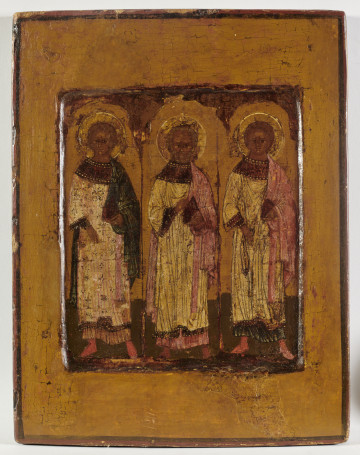
Council of Saints, Council of Saints: Samon, Guriy, Aviv
XVIII/XIX wiek
Castle Museum in Łańcut
Part of the collection: Ikony
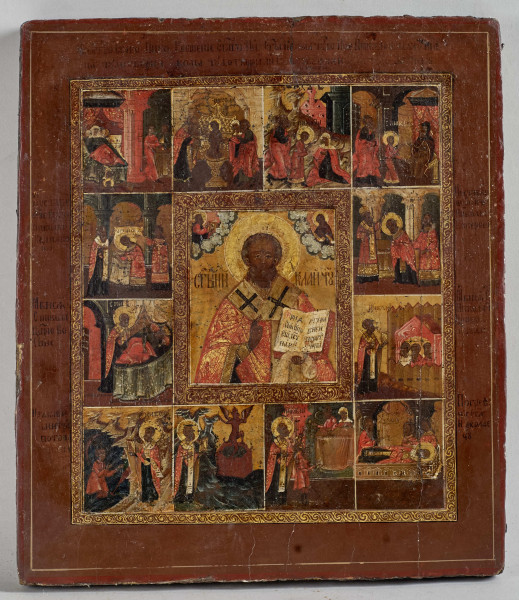
Saint Nicholas the Wonderworker Vita Icon In Christian iconography, one of the most popular figures was St Nicholas the Wonderworker, bishop of Myra in Asia Minor, who lived in the 3rd/4th century. Recognised as a benefactor in times of need, St Nicholas became the patron saint of sailors, fishermen, tailors, weavers, butchers, merchants, millers, stonemasons, brewers, apothecaries, lawyers, schoolchildren, travellers, and women wishing to find husbands. The miracles performed by him during his lifetime and after his death contributed to the rapid development of the cult and the creation of numerous variants of his depiction. In Ruthenia, since the adoption of Christianity, Nicholas the Wonderworker has been continuously venerated by his followers, as evidenced by the significant number of his depictions. In the central part of the icon, the figure of St Nicholas can be seen, and around him are placed twelve scenes from his life and the miracles he performed, such as: 1. Birth; 2. Baptism; 3. Prayer with his parents; 4. Teaching; 5. Diaconate; 6. Designation as bishop; 7. St Nicholas appearing to Emperor Constantine; 8. The rescue of three innocent prisoners; 9. The rescue of Dmitri from the drowning; 10. Casting out an evil spirit; 11. Returning a son from captivity to his parents; 12. The funeral of St Nicholas.
Teresa Bagińska-Żurawska https://orcid.org/0000-0002-9243-3967
Author / creator
Object type
ikony
Technique
tempera, pozłotnictwo
Material
wood, chalk, distemper, gold, paper
Creation time / dating
Creation / finding place
Owner
Muzeum - Zamek w Łańcucie
Identification number
Location / status
XVIII/XIX wiek
Castle Museum in Łańcut

XIX/XX wiek
Castle Museum in Łańcut
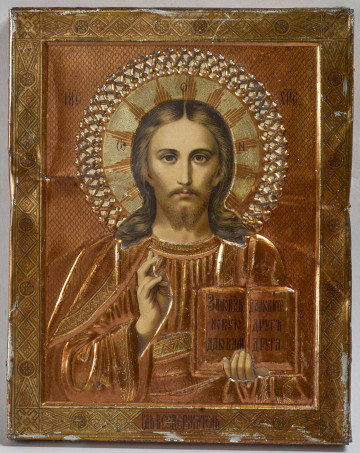
20th century
Castle Museum in Łańcut
DISCOVER this TOPIC
Museum of King Jan III's Palace at Wilanów
DISCOVER this PATH
Educational path