




Men's jacket by ODRA
1964 — 1989
National Museum in Szczecin
Part of the collection: Crafts of the Amazon Indians
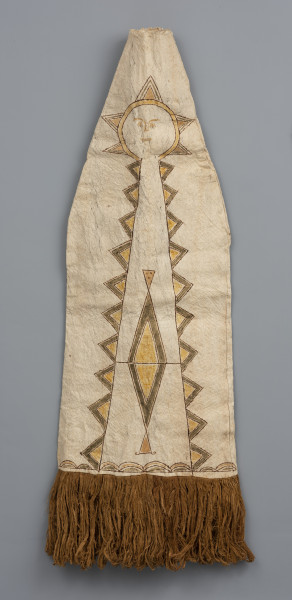
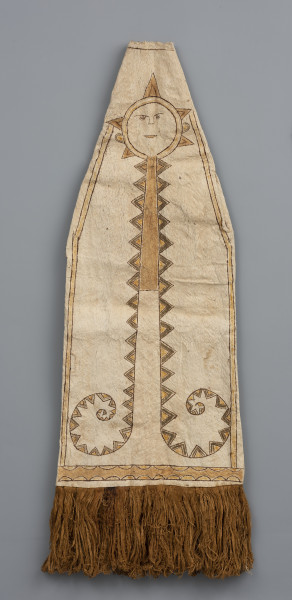
Tukúna (Tikúna) are the indigenous inhabitants of the tropical forests of the state of Amazonas in northwestern Brazil, who call plant fibres obtained from the inner layer of the bark of trees and shrubs, commonly referred to as tapa, are called tururý. The masks prepared from it are made by men. After obtaining the plant material, they soften it in the process of repeated soaking, crushing and drying. Properly prepared tapa is richly decorated. They fill the dark contours sketched with charcoal with various natural plant dyes: yellow, green, red, brown, black. In addition to paintings depicting animals, scenes and characters from Tukún's cosmology, there are images of planes, cars and ships. The presented mask shows mãe de vento – the mother of the wind, a traditional motif of the forces of nature. It symbolizes the spirits that were supposed to protect the main character of the holiday during the girls' initiation rites. In Tukún's beliefs, the wind is also considered to be a force that spreads diseases from the sun.
Tukún's initiation is given to a girl after her first menstruation – it is both a rite of entry into adulthood and a fertility ceremony. Before the ritual, the girl's family prepares a true feast. A large amount of smoked meat and fish, cassava pancakes, bananas, forest fruits and chichy (fermented corn drink) awaits guests. Dozens of dancers put on full-body costumes symbolizing ghosts and dance with the girl being initiated. The Tukúna believe that dancing with ghosts will equip her with the ability to effectively cope with the dangers of adult life. After the rite, masks made of Tururý serve as sleeping mats.
The presented mask was acquired by Ewa Prądzyńska – ethnologist, curator and head of the Department of Non-European Cultures of the National Museum in Nicholas, during field research conducted in Venezuela and Brazil in 2001.
Katarzyna Findlik-Gawron
Other names
mãe de vento (Portuguese)
Author / creator
Object type
ceremonial mask, ceremonial costume, mat
Technique
painting, sewing
Material
plant fiber, tapa (bark fiber), natural dye, plant-based string, charcoal
Origin / acquisition method
field research
Creation time / dating
Creation / finding place
Owner
The National Museum in Szczecin
Identification number
Location / status
1964 — 1989
National Museum in Szczecin

National Museum in Lublin
circa 1650 — 1700
National Museum in Szczecin
DISCOVER this TOPIC
National Museum in Szczecin
DISCOVER this PATH
Educational path