




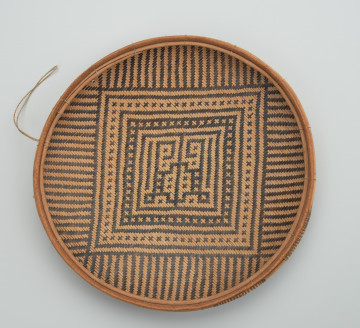
Decorated tray
około 1987
National Museum in Szczecin
Part of the collection: Crafts of the Amazon Indians
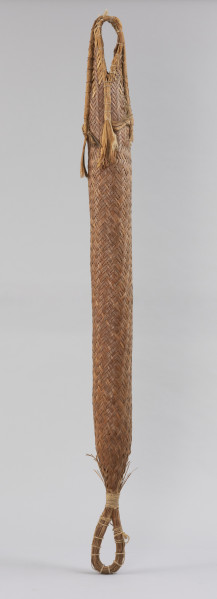
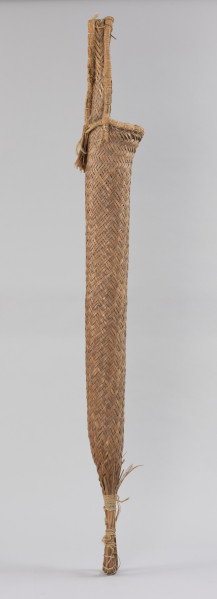
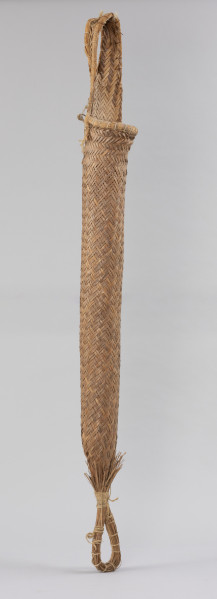
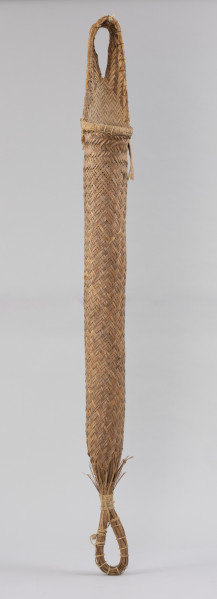
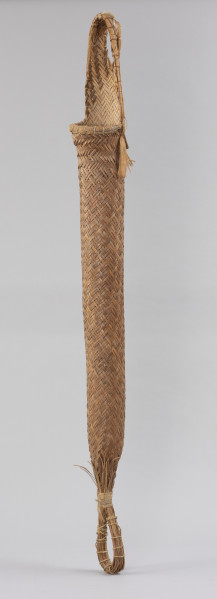
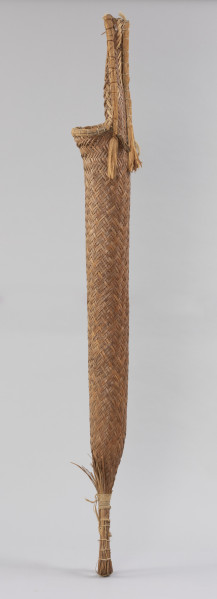
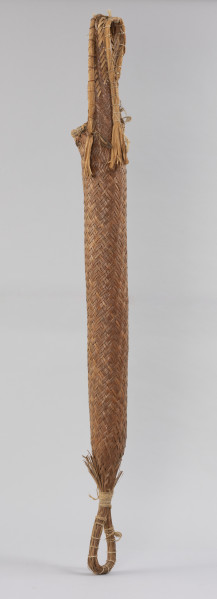
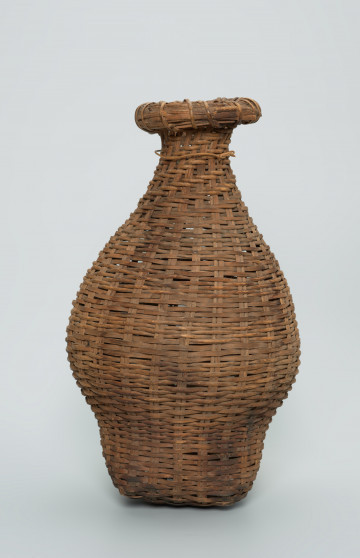
Tingkui is a press, woven from reeds in the Ye'kuana language, used to squeeze prussic acid from bitter cassava, in Spanish called sebucan. Traditionally, among the Ye'kuana people, living mainly in Venezuela, basketry is mainly done by men. Young husbands make a series of braids for their wives in a strictly defined order. The second gift, right after the decorated traywa'ja tomennato, is sebucan.
The basis of their traditional economy is extensive clearing and burning. They grow many plants on their plots, but the most space is occupied by bitter cassava, which has a high content of poisonous prussic acid. To drain the poison, peeled and mashed cassava is put into the sebucan, which is then hung high on a tree trunk or a special community structure that can accommodate several presses at the same time. The poisonous juice is removed by pulling the sebucan using a wooden pole inserted through the bottom loop. To make their work easier, Ye'kuana's women block its end with a specially prepared stump with carved steps. The squeezed poison flows out through the woven walls. After draining the acid, the collected mass is used to prepare casava pancakes, commonly known as "Indian bread" and coarsely roasted mañoco porridge – meals that make up the basic food of Ye'kuan. Although the cultivation of bitter cassava requires more complicated activities than sweet cassava, the Ye'kuana prefer its bitter variety. It is efficient, meals prepared from it are more caloric, and its tubers, due to the high content of prussic acid, are not wormy and stay fresh longer.
The presented sebucan is one of 636 objects acquired during the ethnological research expedition VENEZUELA'85 organized by ethnology students of the Adam Mickiewicz University in Poznań.
Katarzyna Findlik-Gawron
Other names
tingkui (Ye'kuana), sebucan (Spanish)
Author / creator
Object type
press, sieve, basket
Technique
plaiting
Material
tirita reed (ischnosiphon obliquiformis), bast, plant-based string, fishing line
Origin / acquisition method
purchase
Creation time / dating
Creation / finding place
Owner
The National Museum in Szczecin
Identification number
Location / status
około 1987
National Museum in Szczecin
około 1980
National Museum in Szczecin

1851 — 1900
National Museum in Szczecin
DISCOVER this TOPIC
Museum of King Jan III's Palace at Wilanów
DISCOVER this PATH
Educational path