




Saint Paraskevi
XIX/XX wiek
Castle Museum in Łańcut
Part of the collection: Ikony
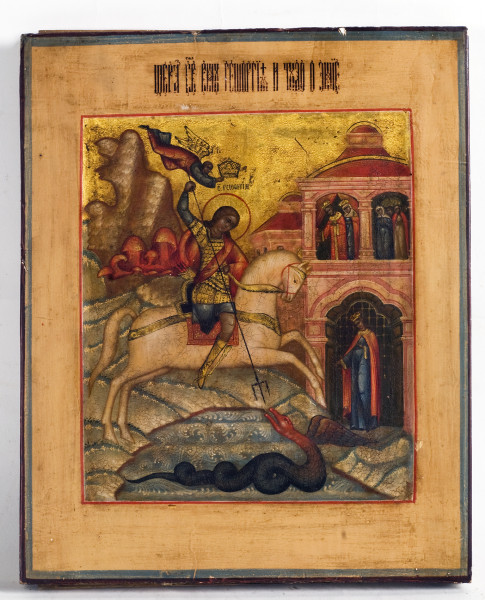
Saint George is among the Warrior Martyrs, widely venerated throughout Ruthenia. He was originally from Cappadocia, a military commander, and a Christian. Despite being tortured during the reign of Emperor Diocletian, he did not renounce his faith and was beheaded by the sword in 303 AD. His body was buried in Lydda, Palestine, while his head was placed in Rome. The developing cult of the saint in both Eastern and Latin Christianity contributed to the creation of numerous images. Initially depicted as a martyr, following the popularisation of the legend of the dragon-slaying, from the 11th century onward, he was portrayed in Roman military attire, with a spear and shield, sometimes with a sword, as a victor over personified evil. According to legend, near the site of the Martyr's burial lived a dragon that terrorised people by devouring them With no one left to save them, the armed Saint George arrived on horseback, carrying a spear marked with a cross, and subdued the beast. He rescued a princess, who led the dragon into the city, tied to her dress sash. In front of the king, Saint George then killed the dragon with his sword. Often, in the upper corner of icons depicting Saint George, the Hand of God and an angel holding a martyr’s crown are shown.
Teresa Bagińska-Żurawska https://orcid.org/0000-0002-9243-3967
Author / creator
Object type
ikony
Technique
tempera, pozłotnictwo
Material
wood, chalk, distemper, gold
Creation time / dating
Owner
Muzeum - Zamek w Łańcucie
Identification number
Location / status
XIX/XX wiek
Castle Museum in Łańcut
20th century
Castle Museum in Łańcut
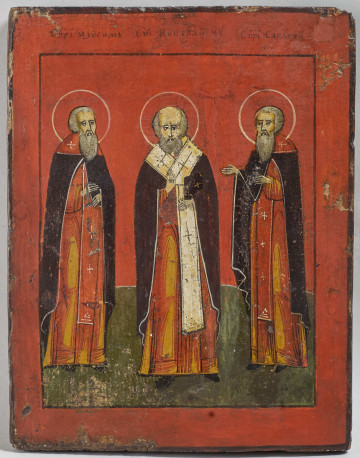
XIX century
Castle Museum in Łańcut
DISCOVER this TOPIC
Museum of King Jan III's Palace at Wilanów
DISCOVER this PATH
Educational path