





Plan of the fortifications of Szczecin with Fort Prussia
1734-03-07
National Museum in Szczecin
Part of the collection: Historic cartography
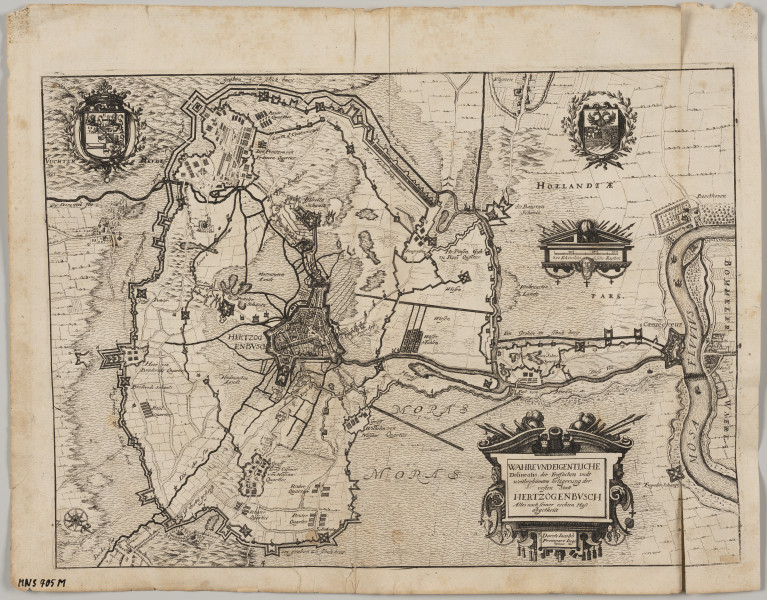
This monochrome map, drawn by engineer Jacobb Prempart, depicts ’s-Hertogenbosch, a city and fortress south of Amsterdam, situated on the rivers Dommel and Meuse, which was besieged from 30 April to 14 September 1629 by the Dutch forces of the Republic of the United Provinces. The fighting stemmed from the ongoing Eighty Years’ War (1568–1648) and the Anglo-Spanish War (1568–1648). The combined Dutch and British forces, led by Prince Frederick Henry of Orange (1584–1647), who was also stadtholder of several Dutch provinces, unexpectedly attacked this major fortress of the Netherlands, which had remained loyal to the Spanish king since 1579, the year of the provinces’ unification.
The map depicts both the city and its fortifications, the positioning of military units, and key topographical features outside the city such as meadows, marshes, large clusters and avenues of trees, churches, water mills, roads, and hills. The rivers and their many canals are also marked: the Aa and Dommel rivers, which converge within the city to form the Dieze, a tributary of the Meuse. Interestingly, the map is oriented toward the southwest, as indicated by the wind rose in the lower left corner pointing to the lower right.
The map’s title and decorative elements also signal the outcome of the siege, which ended favourably for the Republic. In the upper right corner appears the coat of arms of ’s-Hertogenbosch, while in the upper left is the coat of arms of the victorious commander, Frederick Henry of Orange. Both are surrounded by wreaths, but the princely arms are additionally topped by a crown. The cartouches containing the scale and the title are richly ornamented. The cartouche with the map’s scale, given in Prussian rods, is crowned by a panoply with a knight’s helmet at the centre, while its base is adorned with three swags featuring human faces and crosses. On the two-part title cartouche, a cannon sits at the centre of the crowning panoply, with profiled heads on either side, from whose ears hang swags with crosses, set within auricles — elements of the rocaille motif popular in Rococo ornament. Below the cartouche is a large, complex tassel ornament.
Such representations became popular in the sixteenth and seventeenth centuries, alongside the development of modern fortifications. They were primarily a visual record of historical events of political significance, with their cartographic function often being of secondary importance.
Leszek Kocela
Author / creator
Object type
topographic map, city map, graphic
Technique
graphic techniques
Material
paper
Origin / acquisition method
purchase
Creation time / dating
Creation / finding place
Owner
The National Museum in Szczecin
Identification number
Location / status
1734-03-07
National Museum in Szczecin
circa 1787 — 1802
National Museum in Szczecin
2009
National Museum in Szczecin
DISCOVER this TOPIC
Museum of King Jan III's Palace at Wilanów
DISCOVER this PATH
Educational path