




Bodhisattva Avalokiteshvara Padmapani statue
1801 — 1900
National Museum in Szczecin
Part of the collection: Asian art
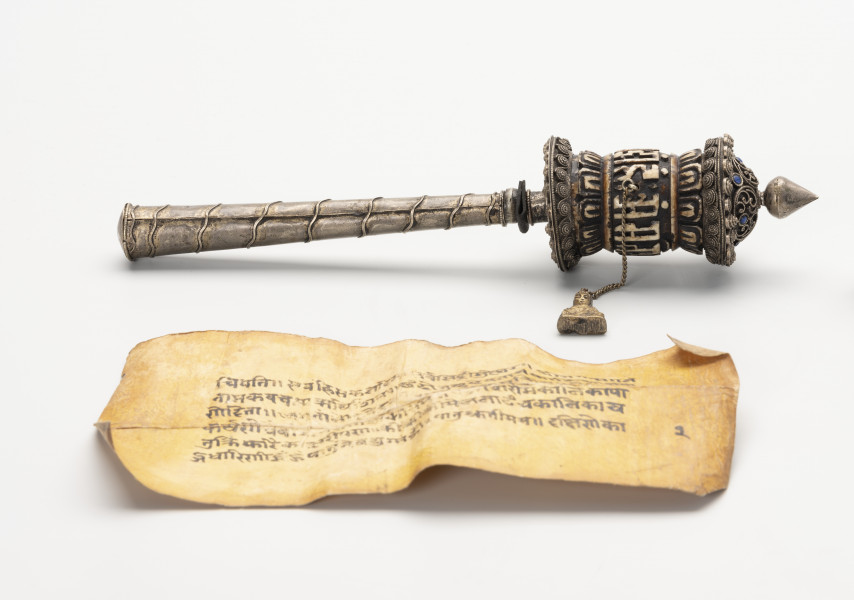
The practice of Tibetan Buddhism is characterized by prayer wheels, which in the language of this region are called mani korlo. On the cylindrical surface they have mantra words written on them. The most commonly used formula is "Om mani padme hum" (praise to the jewel in the lotus). It is a six-syllable mantra to Avalokiteshvara (Tib. Chenrezig), or a being referred to as a bodhisattva of compassion. The repetition of this or the mantra is intended to focus one’s attention on the aspect of Buddha, to separate oneself from thought, to attain liberation and enlightenment. In Tibetan Buddhism, each turn of a prayer wheel is equivalent to saying a mantra aloud. However, these devices are faster than human lips, and what's more, their use is believed to spread positive energy. To strengthen the power of sacred places, larger wheels were placed, for example, on the gates of Buddhist monasteries.
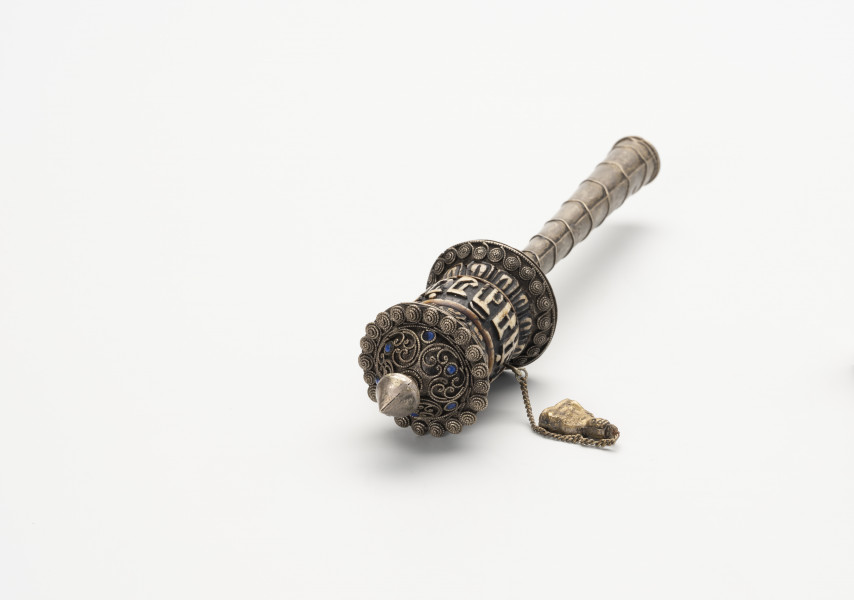
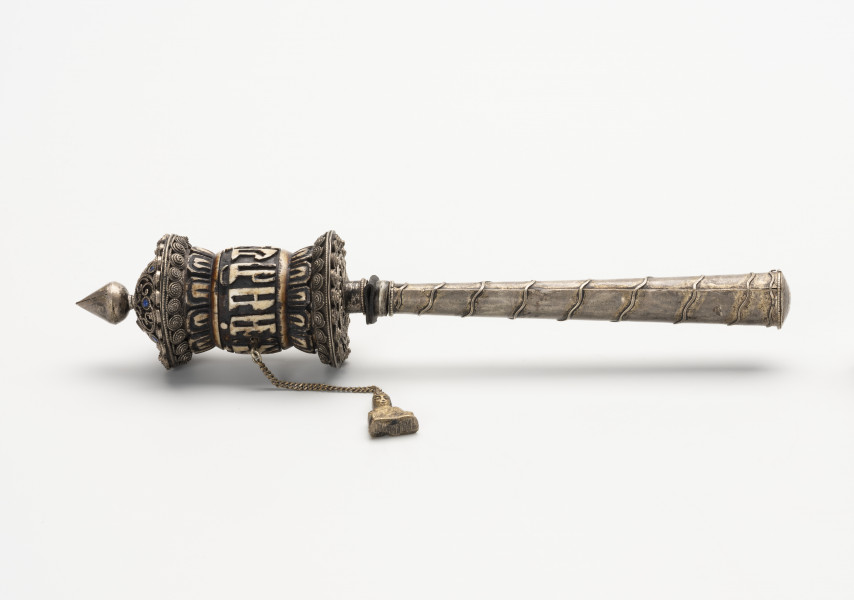
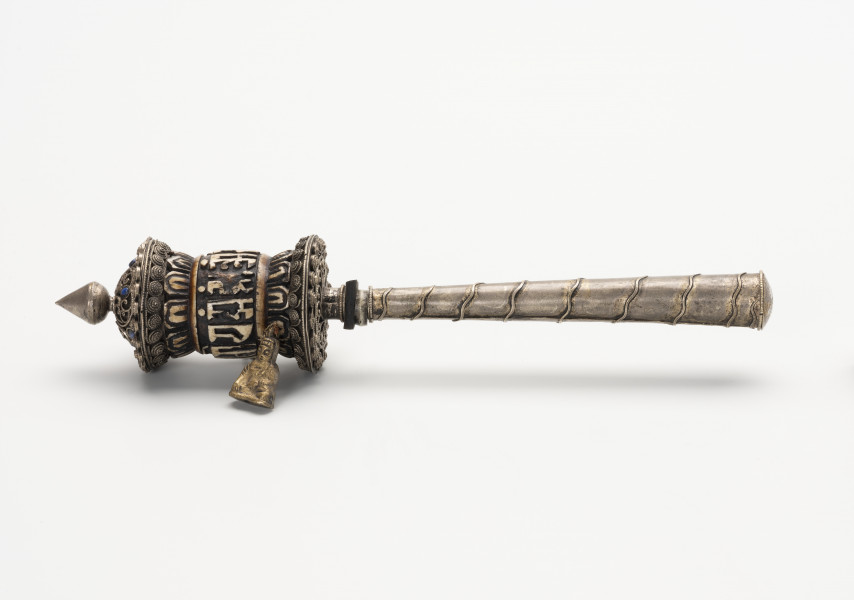
In the presented object, the mantra is surrounded from above and below by a decorative motif of lotus petals. Between the initial and final syllables, a chain with a weight in the form of a tiny brass Buddha figurine was attached to facilitate the rotation of the wheel. The metal elements are decorated with a scroll wheel and plant motif–made of developed volutes and rounded lines, between which there are circles filled with blue enamel. These patterns were made of nickel-plated, densely incised brass plate, thanks to which an effect similar to granulation was obtained. The sleeve-shaped handle is decorated with spirally wavy lines. Wrapped around a spike inside the handle is a folded roll of paper with black text in six rows, written in Tibetan script. It is most likely a quotation from a religious text, as evidenced by the page number of the text marked in the lower right corner – 2. Perhaps it is a fragment of a sutra, or a collection of teachings from Buddha or a later teacher.
Katarzyna Findlik-Gawron
Author / creator
Object type
sacred object, religious text
Technique
casting, repoussage, filigree, niklowanie, sculpture, incrustation
Material
brass, nickel, steel, bone, paper, email
Origin / acquisition method
purchase
Creation time / dating
Creation / finding place
Owner
The National Museum in Szczecin
Identification number
Location / status
1801 — 1900
National Museum in Szczecin

1891 — 1910
National Museum in Szczecin
1901 — 1984
National Museum in Szczecin
DISCOVER this TOPIC
Museum of King Jan III's Palace at Wilanów
DISCOVER this PATH
Educational path