




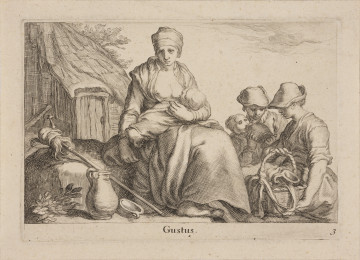
Gustus | Taste
between 1632 — 1670
National Museum in Szczecin
Part of the collection: English graphics
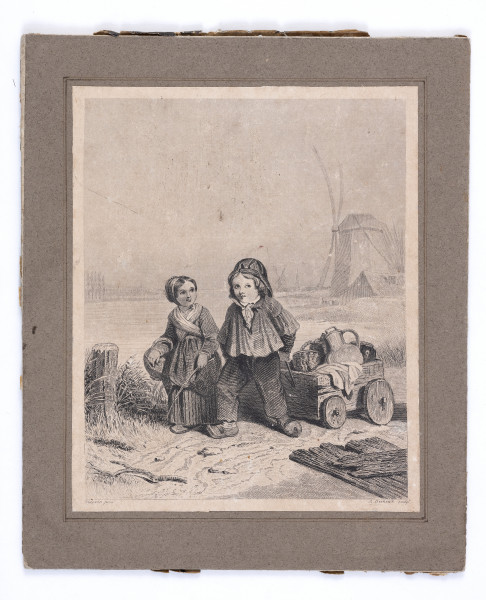
This genre scene, set in a landscape with Breton features, depicts two small children dressed in humble, rural clothing, wearing wooden clogs (sabots), and standing with a cart loaded with dishes. They are positioned in the middle of a plain, between two bodies of water, in front of an old wooden footbridge. The children appear to be on their way to deliver provisions to the fields, ensuring that the farmers working during the harvest will be fed. In the background, a large windmill stands, and on the horizon, the buildings of a village are visible – presumably the children’s starting point for this important task. The scene, which reflects the difficult childhood of 19th-century rural children, carries elements of social critique typical of the second half of the 19th century. This is reminiscent of the literary works of Charles Dickens, which similarly highlight societal issues. The image is based on a composition by Théodore Valerio (1795–1845), an Italian painter, engraver, and traveller born in Herserage, southern France, and who died in Vichy. Valerio debuted in 1838 at the Salon des Artistes Vivants, where he exhibited until his death. He had a particular interest in ethnographic themes, often portraying landscapes, genre scenes, human types, and military subjects. His travels took him across Germany, Austria, Hungary, Romania, Switzerland, Italy, the Balkans, and Turkey. Valerio also spent many years in Brittany, which he first visited in 1843, and he travelled to England as well. His works, praised by Théophile Gautier (1811–1872), were reproduced in lithographic and etching albums. The described print likely originates from such an album. The engraver, Andrew Duncan (1795–1845), studied at the Royal Academy in London from 1814. He worked in London until 1845 as a reproductive engraver, illustrator, portraitist, and creator of biblical, genre, and military scenes, as well as landscapes inspired by both old and contemporary painters. His illustrations appeared in publications such as those describing the collection of antique figures from the British Museum in London. Duncan employed copperplate and steel engraving techniques. Ewa Gwiazdowska
Author / creator
Object type
chalcography (print), reproductive prints
Technique
copper engraving, etching
Material
paper, cardboard
Origin / acquisition method
acquisition
Creation time / dating
Creation / finding place
Owner
Muzeum Narodowe w Szczecinie (1945- )
Identification number
Location / status
between 1632 — 1670
National Museum in Szczecin
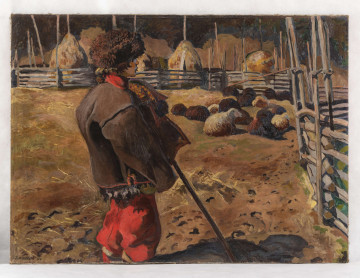
1906
National Museum in Lublin
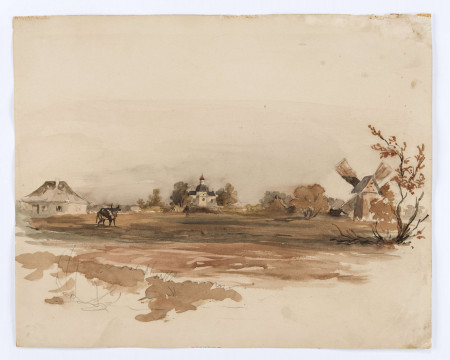
1853
National Museum in Lublin
DISCOVER this TOPIC
Museum of King Jan III's Palace at Wilanów
DISCOVER this PATH
Educational path