



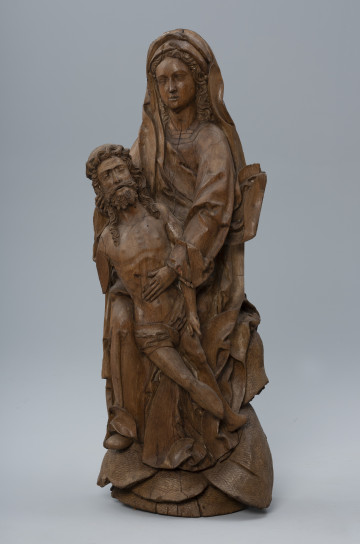
Pietà
circa 1520
National Museum in Szczecin
Part of the collection: Medieval sculpture of West Pomerania
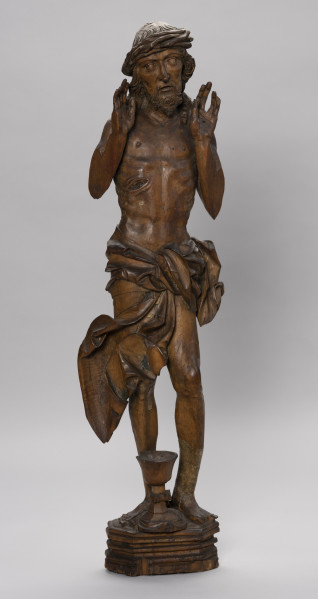
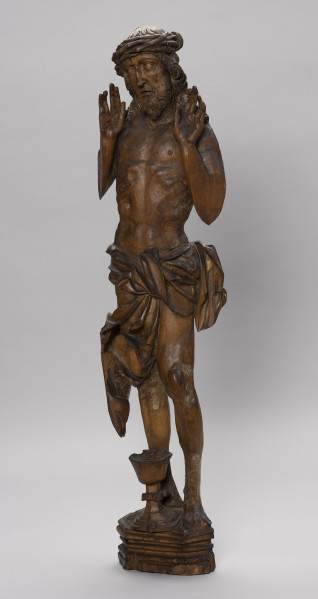
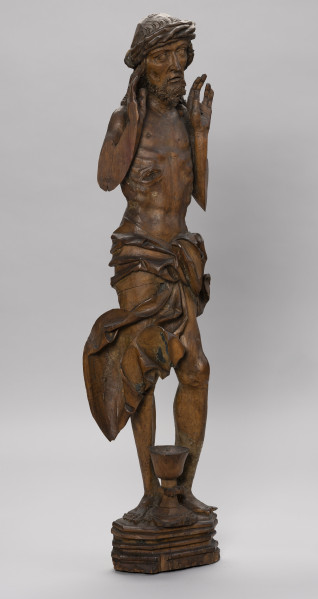
Depictions of Christ displaying the realistically rendered wounds of his crucifixion are referred to as Vir Dolorum (Latin for Man of Sorrows). These images were devotional in nature and associated with the veneration of the Five Holy Wounds of Christ. The Pomeranian sculpture represents one variant of this motif in art. The Saviour raises his hands in a gesture of an orant, hence the figure is also called the Interceding Christ. This depiction, extremely popular in the late Middle Ages, served as a visual affirmation of the redemption accomplished on the cross while also offering the comforting assurance of the Redeemer’s constant intercession before God.
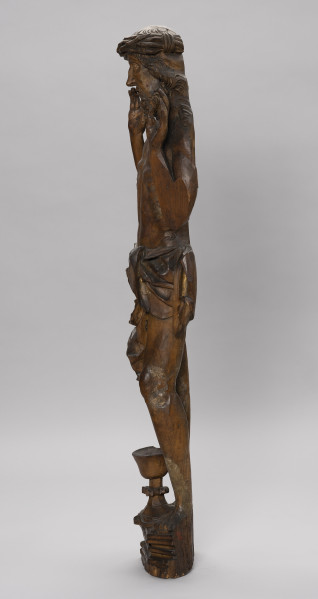
The chalice at the foot of the Pomeranian figure adds an Eucharistic dimension to the representation. The motif of blood flowing directly from Christ’s pierced side into the liturgical vessel was intended to vividly convey the doctrine of transubstantiation, a subject of significant theological debate on the eve of the Reformation.
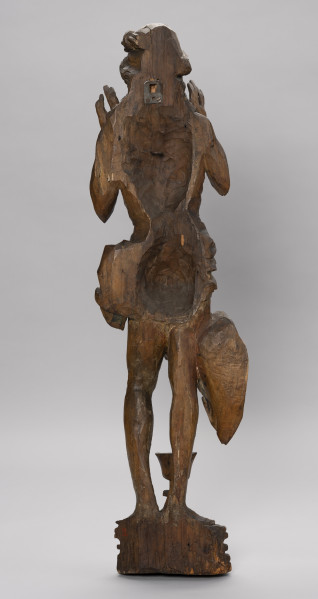
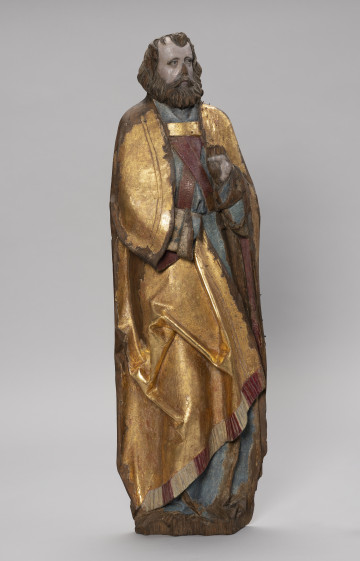
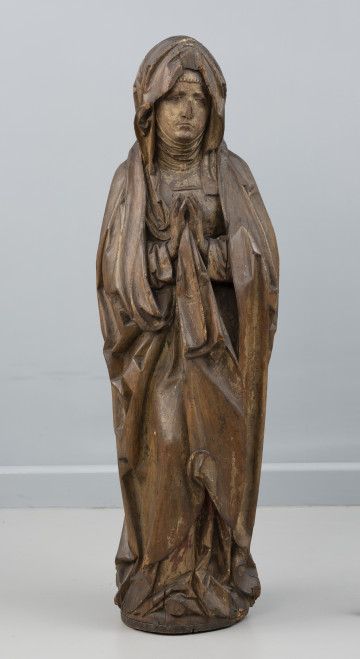
Designed as an altarpiece, the sculpture likely stood at the centre of a retable, flanked by figures of Our Lady of Sorrows (MNS/Szt/90) and a Holy Bishop, both also preserved in the museum’s collection (MNS/Szt/184). An archival photograph from 1907 shows the figures together against a building façade, with a caption below reading “Kreis Greifenhagen” (Greifenhagen District), suggesting the group originated from the former Gryfino County.
The creation of the Suffering Christ sculpture is linked to the activity of a late medieval workshop in Szczecin. Its maker was inspired by the works of Tilman Riemenschneider (c. 1460–1531), closely replicating the type of crucifixion imagery seen in many of Riemenschneider’s works. The strongest resemblance is to the Man of Sorrows figure that once crowned the Heilig-Blut-Altar (Holy Blood Altar) in the Church of St. James in Rothenburg ob der Tauber, dated to c. 1501–1504.
The sculpture is displayed in the permanent exhibition The Mystery of Light: Medieval Art in Pomerania.
Kinga Krasnodębska
Author / creator
Object type
figure, sacred object
Technique
sculpture, polychrome
Material
linden wood, paint
Origin / acquisition method
legal transfer
Creation time / dating
Creation / finding place
Owner
The National Museum in Szczecin
Identification number
Location / status
circa 1520
National Museum in Szczecin
1520 — 1530
National Museum in Szczecin
circa 1500 — 1520
National Museum in Szczecin
DISCOVER this TOPIC
Museum of King Jan III's Palace at Wilanów
DISCOVER this PATH
Educational path