



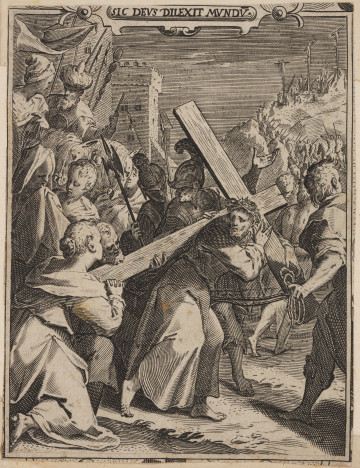
Sic deus dilexit mundu | For God so loved the world
1590
National Museum in Szczecin
Part of the collection: Renaissance and Baroque painting
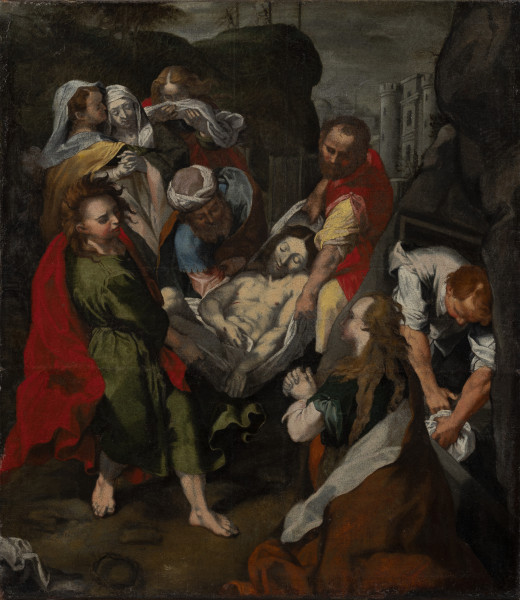
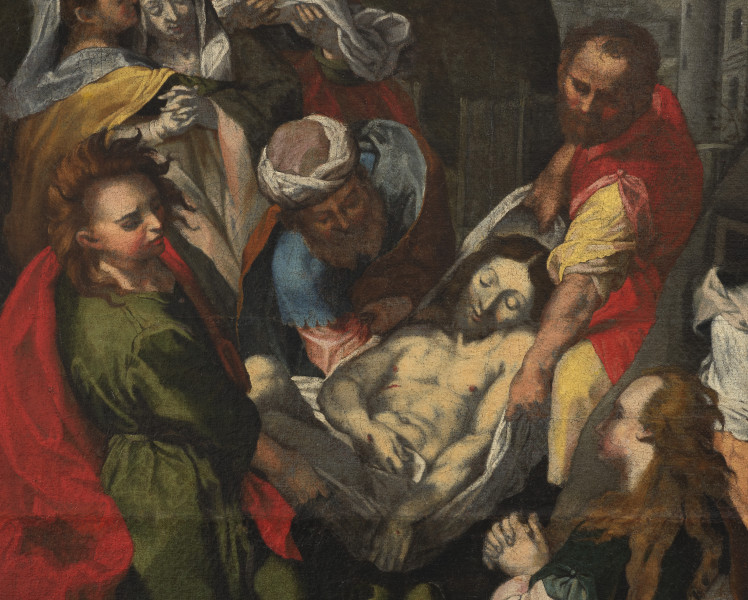
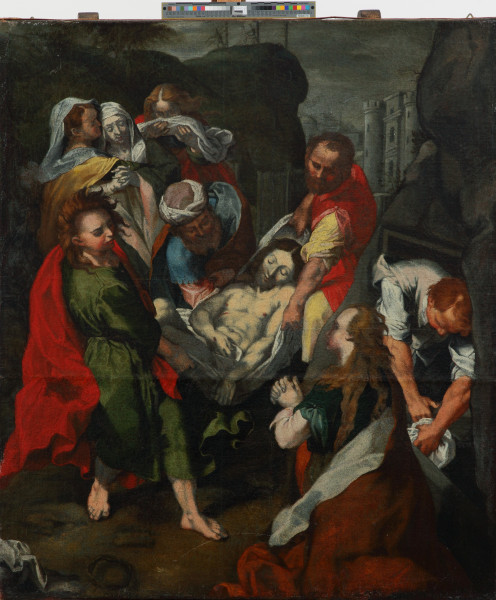
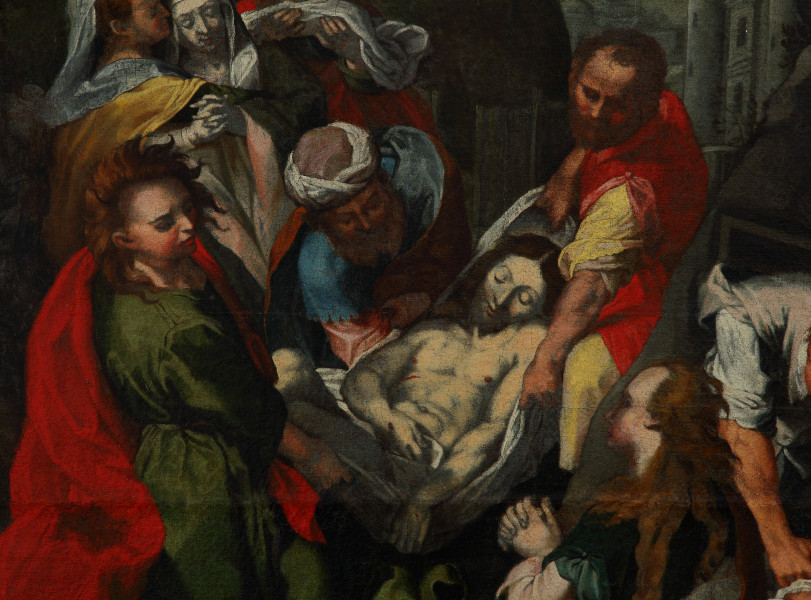
The burial scene unfolds against a rocky, sombre landscape with a sky shrouded in grey clouds. At the centre of the composition, the pale body of Christ lies on a cloth, carried by Saint John the Evangelist on the left and Saint Nicodemus on the right. Behind them, Joseph of Arimathea, who offered his tomb for Christ’s burial, supports Christ's left arm, leaning over him. In the foreground, to the right, Mary Magdalene kneels, her hands clasped in prayer. Beside her, Abenadar, a Roman soldier who witnessed Christ's martyrdom and was one of the first converts, leans forward. In the background, Mary mourns the death of her son, accompanied by women who can be identified as her sisters: Mary Salome and Mary of Clopas. This painting is modelled on a Renaissance reproductive print depicting Federico Barocci’s The Entombment of Christ from 1582, painted for the Church of the Holy Cross in Senigallia, Italy. Barocci’s expressive composition, based on intersecting diagonal lines defined by the arrangement of the figures, became a popular template for altarpieces in Northern Europe. The Szczecin version, created by an unknown Pomeranian guild painter in the 17th century, features slight modifications to the original. The grey silhouette of a building inspired by the Palace of Urbino lacks the tower helmets seen in the original, while only the bases of three crosses are visible on the hill. In the lower-left corner, a crown of thorns lies on the ground, but the instruments of Christ's Passion, present in Barocci's work, are absent. The background is notably darker than in the Italian original, and the clothing features more varied and contrasting colours, juxtaposing vibrant reds and yellows with cool blues and greens. Despite these differences, which result from using a print as the model, the regional artist preserved the dynamism of the Mannerist original in their version. Justyna Bądkowska
Author / creator
Object type
painting
Technique
oil technique
Material
canvas
Origin / acquisition method
acquisition
Creation time / dating
Creation / finding place
Owner
The National Museum in Szczecin
Identification number
Location / status
1590
National Museum in Szczecin

circa 1505 — 1515
National Museum in Szczecin
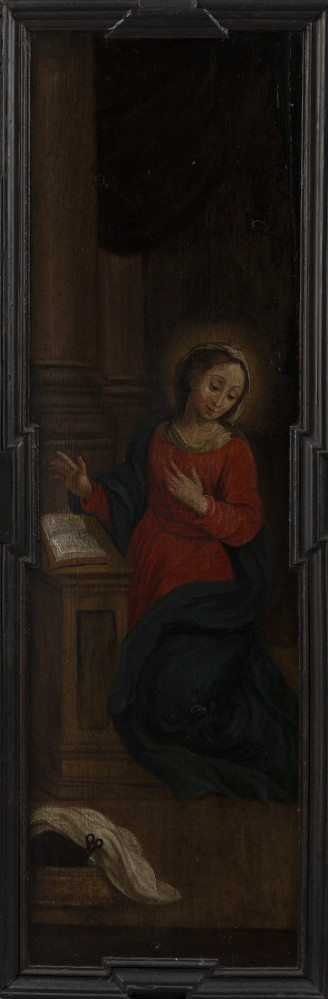
1600 — 1700
National Museum in Szczecin
DISCOVER this TOPIC
Museum of King Jan III's Palace at Wilanów
DISCOVER this PATH
Educational path