



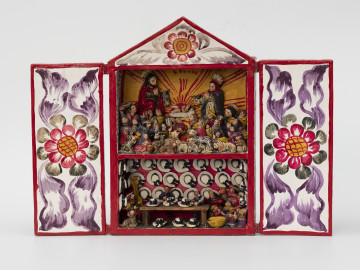
The Nativity of Baby Jesus (a hat Seller)
circa 1970 — 1975
National Museum in Szczecin
Part of the collection: Indigenous Latin American Communities Crafts
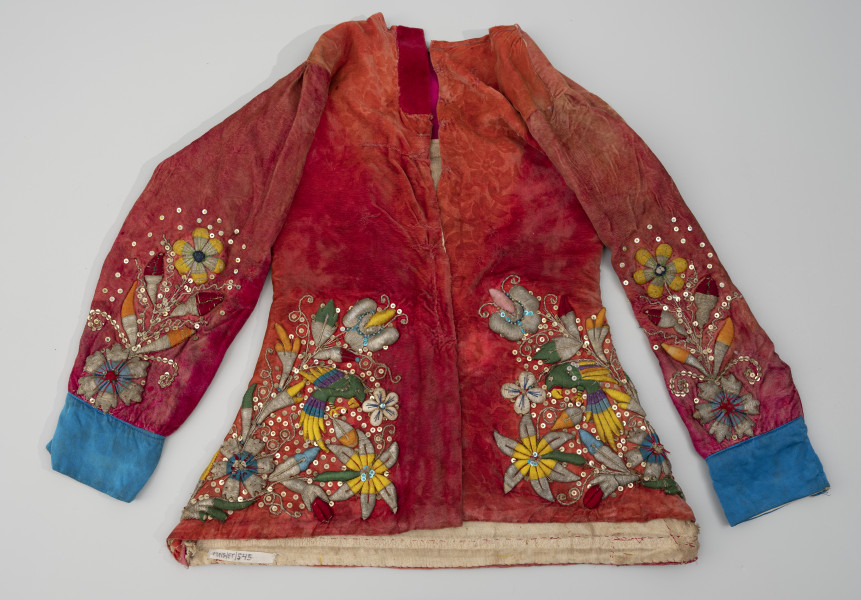
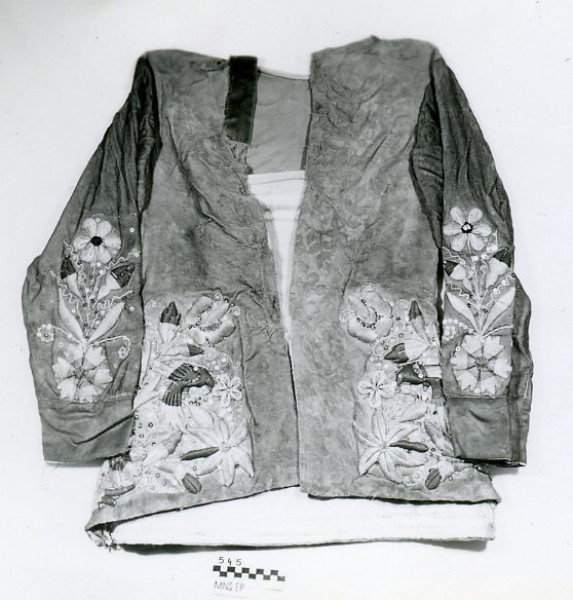
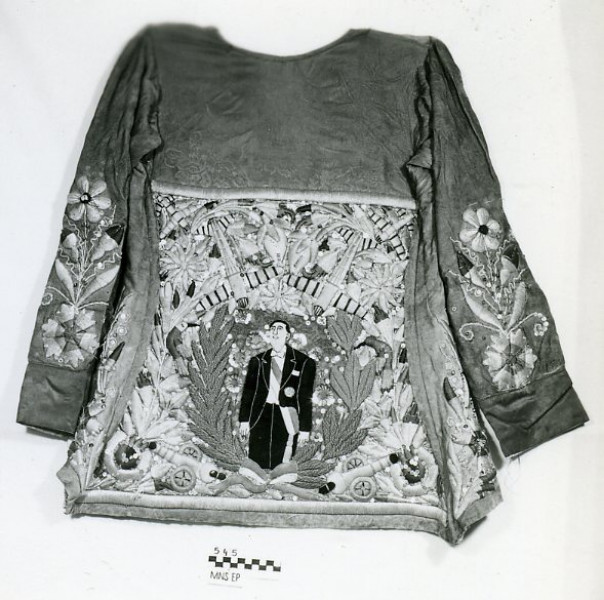
A richly decorated kaftan is part of the men's costume used for the negritos dance (danza de los negritos or cofradía de los negritos). Particularly noteworthy is the figure of Peruvian President Fernando Belaúnde Terri (1912–2002), who ruled from 1963 to 1968 and 1980 to 1985, incorporated into the embroidery on the back. Next to national heroes, religious motifs and floral patterns appear on kaftans. The costume of the negritos dancers also consists of trousers and aprons decorated with embroidery and fringes, headpieces decorated with feathers and mirrors, whips with bells with which the dancers simulate blows, and white and black leather masks symbolizing the African inhabitants of Peru and the Spanish.
Negritos is a group or brotherhood of costumed dancers performing on the occasion of local holidays or religious and folklore festivals. They entertain the audience with dances performed with choreography based on energetic movements and comical gestures. Although today danzas de los negritos are performed by mestizos, their origins date back to colonial times and the African population brought to Peru. At Christmas, slaves were granted a few days of freedom, which they spent in adoration of the Baby Jesus, visiting nativity scenes and churches.
The kaftan on display most likely comes from the town of Huancayo (Junín region), known for its danzas de los negritos, however, it was purchased in the village of Huacho sin Pescado (Lima region) by the participants of the Polish Scientific Expedition to the Andes, organized in 1978 to Peru and Bolivia. The co-organizer of the expedition, Prof. Aleksander Posern-Zieliński, described the circumstances of the purchase in one of the publications: "Fortunately, several such kaftans ended up in Polish museums thanks to the fact that their owner urgently needed money to settle some important matter in Lima."
Katarzyna Findlik-Gawron
Author / creator
Object type
caftan, ceremonial costume, festiv costume, menswear
Technique
embroidery, sewing
Material
synthetic velour, cotton, satin, sequins, glass beads, cotton thread, plastic thread, plant fiber thread, silk thread, woolen thread, metallized thread
Origin / acquisition method
purchase
Creation time / dating
Creation / finding place
Owner
The National Museum in Szczecin
Identification number
Location / status
circa 1970 — 1975
National Museum in Szczecin
1978
National Museum in Szczecin

1600 — 1625
National Museum in Szczecin
DISCOVER this TOPIC
National Museum in Lublin
DISCOVER this PATH
Educational path