




De Kriusoprichting | The Elevation of the Cross
1638
National Museum in Szczecin
Part of the collection: Renaissance and Baroque painting
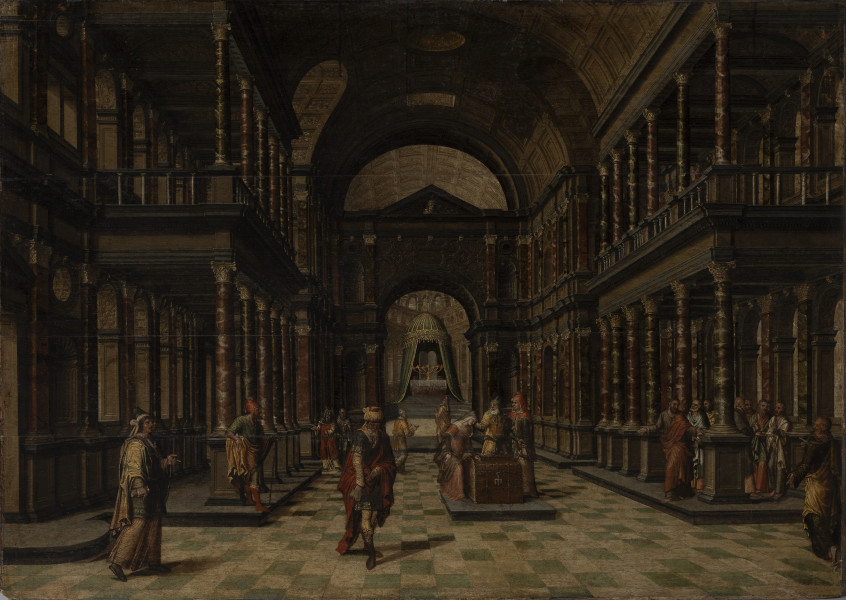
In the Temple of Solomon in Jerusalem, as Jesus observed people giving donations to the temple treasury, he drew the apostles’ attention to a poor widow who offered just a single mite. He explained to them that she had “put in more than all those who are contributing to the treasury. For they all gave out of their wealth; but she, out of her poverty, put in everything she had to live on” (Mark 12:43–44).
The presented painting, The Widow’s Mite, depicts Jesus addressing his disciples walking behind him, pointing toward the chest in the centre of the temple where a modestly dressed woman reaches into her purse for coins. A man in the foreground, dressed in splendid gold-trimmed robes, performs a similar gesture of reaching into his purse. The juxtaposition of these two figures highlights the significance of Jesus’s words, underscoring the meaning of a true offering.
The scene is set within the monumental interior of a sacred structure envisioned as the Jerusalem Temple. The unknown artist demonstrated a profound understanding of ancient architecture and the principles of converging perspective, creating the illusion of space. The scientific foundations of such perspective were developed in the 15th century by the Florentine architect Filippo Brunelleschi (1377–1446). In the late 16th and early 17th centuries, compositions featuring figurative scenes placed in imaginary interiors became popular in Northern Europe. These interiors were designed according to the principles of linear perspective, often with a vanishing point offset from the axis, as seen in The Widow’s Mite. This style was popularised through architectural pattern books by the Dutch architect and painter Hans Vredeman de Vries (1527–1609).
Monika Frankowska-Makała
Author / creator
Object type
painting
Technique
oil technique
Material
plank, canvas
Origin / acquisition method
purchase
Creation time / dating
Creation / finding place
Owner
The National Museum in Szczecin
Identification number
Location / status
1638
National Museum in Szczecin
1638
National Museum in Szczecin

1799
National Museum in Szczecin
DISCOVER this TOPIC
Museum of King Jan III's Palace at Wilanów
DISCOVER this PATH
Educational path