



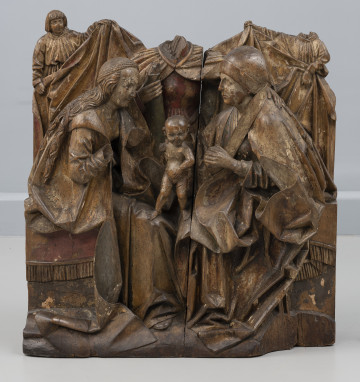
Saint Anne with Mary, the Christ Child, and Emerentia
circa 1515 — 1520
National Museum in Szczecin
Part of the collection: Medieval sculpture of West Pomerania
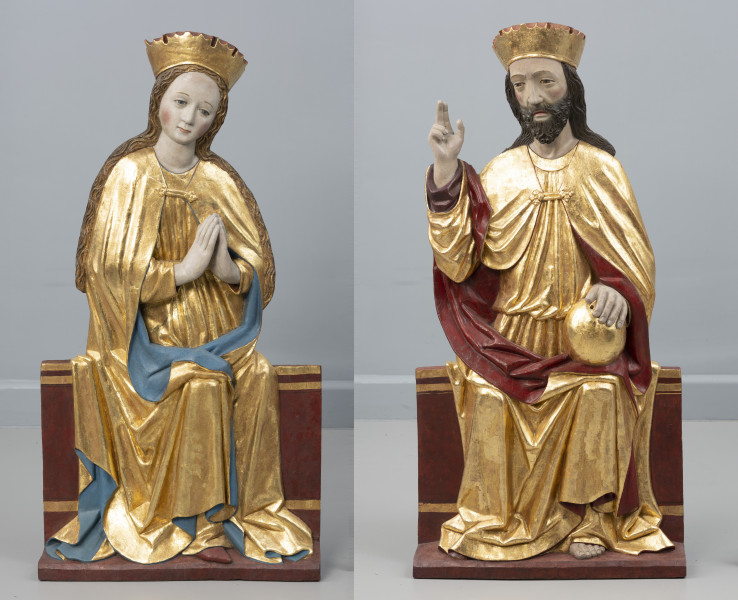
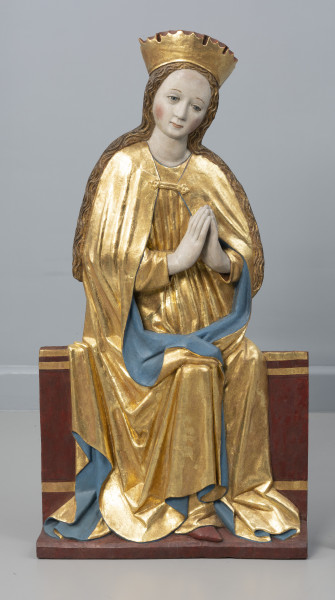
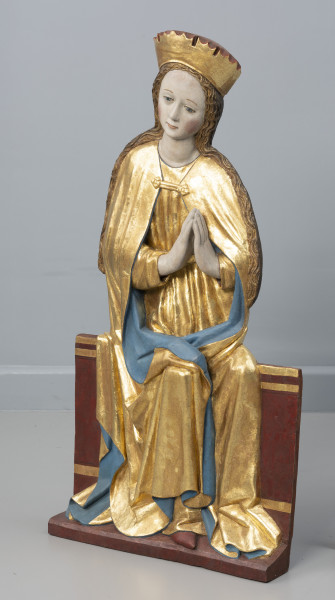
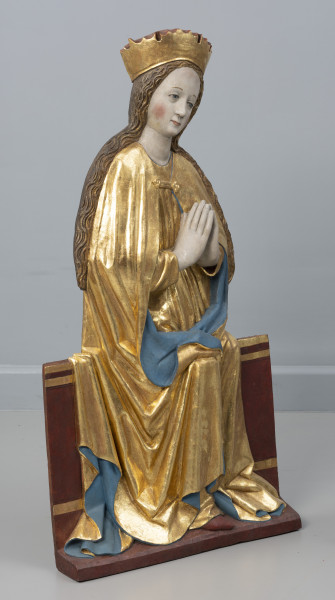
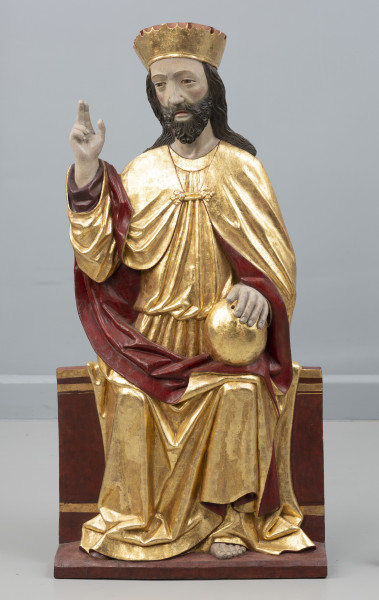
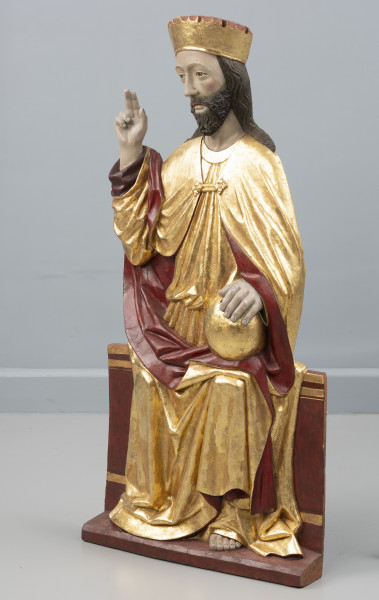
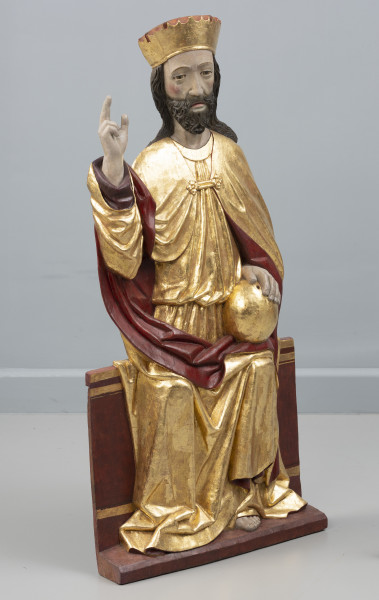
The two-figure depiction of the Coronation of the Blessed Virgin Mary represents a variant of the scene following the coronation ceremony, in which the Virgin Mary is seated on a throne, crowned, next to Christ who blesses her. Her crown symbolises the gift of eternal life, her admission to the Kingdom of Heaven, and her title as Queen of Heaven. The gestures of her bowed head and hands clasped in prayer signify humility and intercession for humanity. Mary’s gentle appearance, with a serene, radiant face and subtle posture, contrasts with the stern and solemn, divinely majestic countenance of Christ. Fitting his role, Christ – seated on the throne, majestically upright as Rex regnantium (King of Kings) – blesses his Mother with his right hand while holding a golden orb, symbolising his dominion over the world, in his left.
Scenes of this kind are among the Christian iconographic motifs glorifying Mary, popular in Gothic art. They are found in portal sculptures of French cathedrals from the late 12th and early 13th centuries, as well as in numerous altarpiece representations.
The sculptural group of the Coronation of Mary forms the central panel of the monumental altar from the Church of St. John in Stargard, known as the Stargard Polyptych. This multi-element altarpiece is one of the most renowned Gothic art monuments from Western Pomerania. The richly gilded retable is filled with diverse sculpted and painted representations, forming a thematic yet conceptually and structurally unified iconographic program. The scale and subject matter of the altar reflect the significance of the Stargard church while also honoring Mary, the patron of the altar’s founders, the Knights Hospitaller of Stargard.
The style of the altar’s sculptures shows affinities with works from the early 15th century in northern Germany, particularly Mecklenburg. The artistic models from that region, rooted in Netherlandish and Westphalian art, reached Pomerania through the networks of Hanseatic centers and the religious orders, which maintained creative exchanges and rich sources of inspiration among their various commanderies.
The work is displayed in the permanent exhibition The Mystery of Light: Medieval Art in Pomerania.
Kinga Krasnodębska
Author / creator
Object type
relief, sacred object, altar element
Technique
sculpture, polychrome, gilding
Material
oak wood, paint, złocenia
Origin / acquisition method
legal transfer
Creation time / dating
Creation / finding place
Owner
The National Museum in Szczecin
Identification number
Location / status
circa 1515 — 1520
National Museum in Szczecin
circa 1520 — 1530
National Museum in Szczecin
circa 1520
National Museum in Szczecin
DISCOVER this TOPIC
National Museum in Lublin
DISCOVER this PATH
Educational path