




The Widow’s Mite
1600 — 1625
National Museum in Szczecin
Part of the collection: Goldsmith craftsmanship
The Chevra Kadisha, or Holy Society, was a Jewish communal organisation responsible for caring for the dying, performing ritual purification and dressing of the deceased, arranging burials, and supporting the bereaved family. In communities without a separate society for caring for the sick, the Chevra Kadisha would also take on those duties. In the modern era, funeral societies operated within every Jewish community, funded through voluntary donations and offerings.
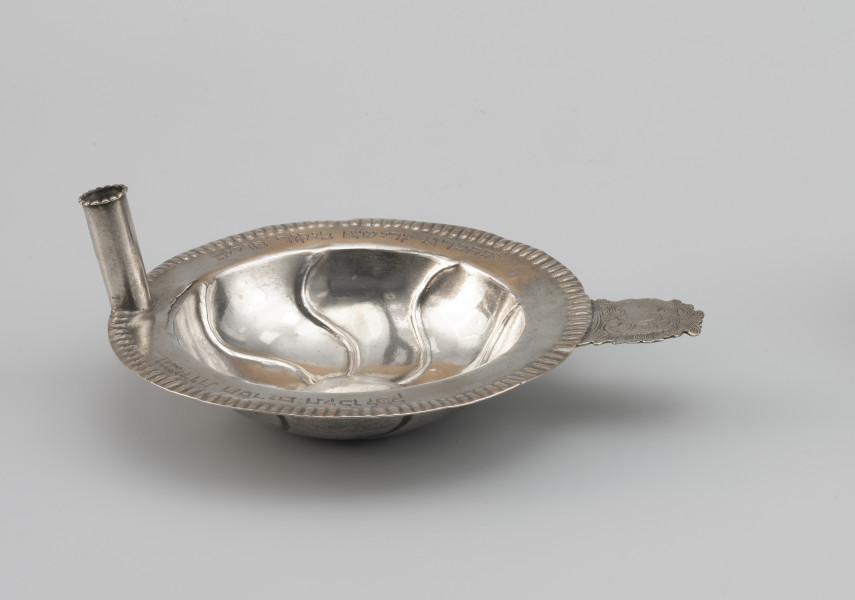
The rococo donation bowl held in the Szczecin collection is a rare artifact that was used in a burial society. The engraved inscription indicates that the bowl was dedicated to the Chevra Kadisha in the Hebrew year 5526, corresponding to 1765–1766 in the Gregorian calendar. The inscription does not specify the location of the society, but the maker’s mark identifies Neustrelitz as the place of the bowl’s manufacture.
Neustrelitz was a residential town in Mecklenburg, just west of Pomerania. It was established near the new residence of the Dukes of Mecklenburg-Strelitz, constructed in 1733 after the old palace in nearby Strelitz burned down. In the early 18th century, the dukes allowed Jewish families to settle in Neustrelitz under their protection.
Jews had returned to Mecklenburg after a long absence caused by persecution and expulsion at the end of the 15th century, following accusations of host desecration in the church at Sternberg. The Jewish community in Neustrelitz quickly flourished. A Jewish cemetery was established in 1728, and in 1763 the synagogue was ceremonially opened.
It is highly likely that this silver donation bowl, crafted in the mid-1760s in Neustrelitz, was created for the use of this Jewish community, which was then the largest in Mecklenburg.
Monika Frankowska-Makała
Author / creator
Object type
container, bowl
Technique
forging, repoussage, curving (engraving), cutting out
Material
silver
Origin / acquisition method
legal transfer
Creation time / dating
Creation / finding place
Owner
The National Museum in Szczecin
Identification number
Location / status
1600 — 1625
National Museum in Szczecin
1201 — 1225
National Museum in Szczecin
1175 — 1200
National Museum in Szczecin
DISCOVER this TOPIC
Museum of King Jan III's Palace at Wilanów
DISCOVER this PATH
Educational path