




Flint axe
3100 p.n.e. — 2500 p.n.e.
National Museum in Szczecin
Part of the collection: Stone Age
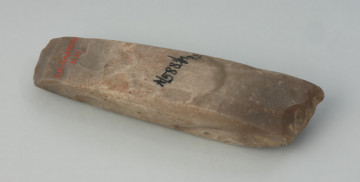
The flint axe from the vicinity of Stary Chwalim belongs to a group of objects from the former Pommersches Landesmuseum in Szczecin (1927–1945), for which provenance details are difficult to establish from the surviving archival records. Typically, despite the wartime destruction of inventory books, information about similar finds can be found in other types of documentation. For unknown reasons, however, this artefact was not recorded in archaeological find reports, nor is it mentioned in publications listing new acquisitions to the museum's collection. It appears only in a post-1947 inventory of the contents of crates in which the museum’s prehistoric holdings were packed away at the end of the Second World War. The flint axe, labelled P.S. 1511 – a number still visible on the present specimen – is listed there as a find without a noted place of origin. The identification of its provenance was made in the late 1950s or early 1960s, based on a pre-war photograph, as a discovery from Alt Vilm (now Stary Chwalim). Shortly afterwards, however, it was mistakenly catalogued together with a similar axe as a find from Rębowo. It is likely that the axe was among the many chance discoveries of objects without archaeological context typical of the time, and it probably entered the museum collection around 1932, as this was when other items with similar inventory numbers were acquired. The object was first published in 1962 in a study of striped flint artefacts found in Western Pomerania. It remains one of the few tools made from this material discovered in the region. Its form and characteristics match flint axes associated with the Globular Amphora culture of the Late Neolithic. Communities belonging to this archaeological culture mined striped flint in the Świętokrzyskie region using underground mining techniques. Tools made from this highly prized and visually distinctive material – mainly axes and chisels – were then distributed across sometimes considerable distances. Krzysztof Kowalski
Author / creator
Object type
axe
Technique
core reduction (lithics), grinding, smoothing
Material
striped flint
Origin / acquisition method
acquisition
Creation time / dating
Creation / finding place
Owner
The National Museum in Szczecin
Identification number
Location / status
3100 p.n.e. — 2500 p.n.e.
National Museum in Szczecin
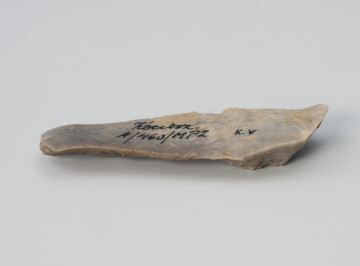
12700 p.n.e. — 11500 p.n.e.
National Museum in Szczecin
3100 p.n.e. — 2600 p.n.e.
National Museum in Szczecin
DISCOVER this TOPIC
Castle Museum in Łańcut
DISCOVER this PATH
Educational path