



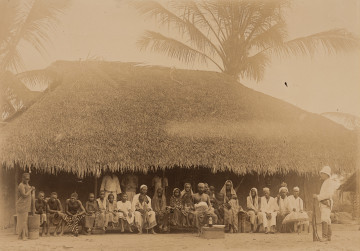
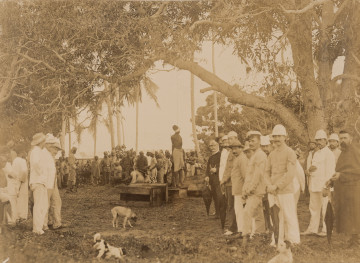
König Ringu mit Gefolge (König Kingu mit Gefolge?) | King Ringu with his entourage (King Kingu with his entourage?)
1893 — 1900
National Museum in Szczecin
Part of the collection: From the history of non-European expeditions
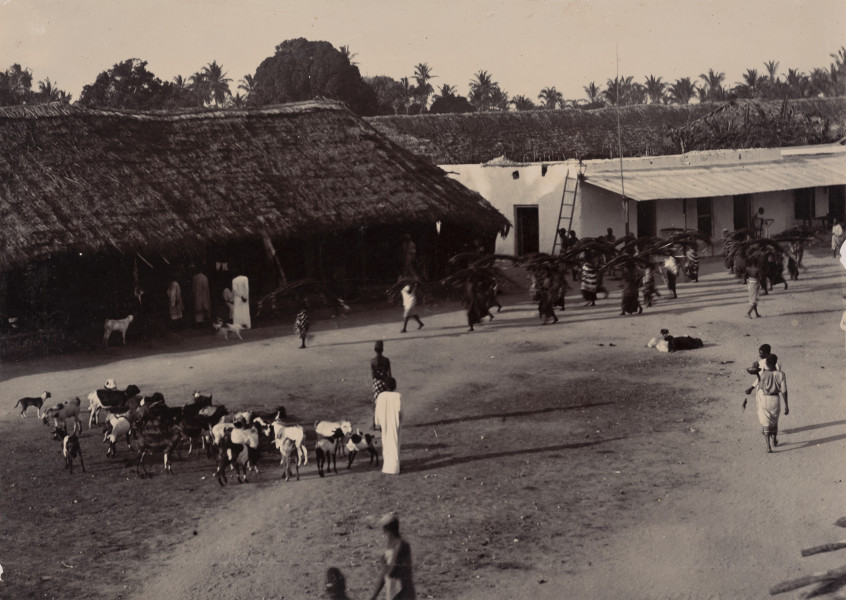
The photograph showing a group of local porters comes from the album of Aleksander Dandelski (1863–1944), a Prussian officer who served in German East Africa (today’s Tanzania, Rwanda, and Burundi) at the end of the 19th century. Although the photograph was originally titled Elfenbein Karawanen (“Ivory Caravan”), after careful analysis, it was determined that this title does not reflect the true contents of the image. The goods being transported cannot be ivory, as a single tusk from an adult male elephant would weigh over 100 kg, and the porters are seen carrying up to 10 pieces on their heads. It is most likely that they are transporting sugarcane to the nearest railway station. From the beginning of German East Africa’s existence, the colony’s policies were heavily focused on exploiting the occupied territory. The main goal was to extract as much financial gain as possible from the region’s resources. The local population was forced to leave their native lands, subjected to heavy taxation, and compelled into forced labour in gold, diamond, and copper mines, on sisal (agave) plantations, coffee, cotton, sugarcane plantations, and in the construction of railways. They were also made to work in the transport of goods, loading and unloading ships at ports. Many raw materials were exported from the German colony, facilitated by a railway line connecting the areas around Lake Tanganyika with ports on the Indian Ocean coast. The largest shipments from the interior – mainly ivory, gold, and timber – were sent to the ports of Dar es Salaam and Bagamoyo. The former served as the administrative and commercial hub from 1890 to 1918, while the latter was the capital of the German colony from 1885 to 1890. By Katarzyna Findlik-Gawron
Author / creator
Object type
photograph
Technique
black-and-white photography
Material
photographic print paper, cardboard, leather
Origin / acquisition method
donation
Creation time / dating
Creation / finding place
Owner
The National Museum in Szczecin
Identification number
Location / status
1893 — 1900
National Museum in Szczecin
1893 — 1900
National Museum in Szczecin
1893 — 1900
National Museum in Szczecin
DISCOVER this TOPIC
National Museum in Lublin
DISCOVER this PATH
Educational path