




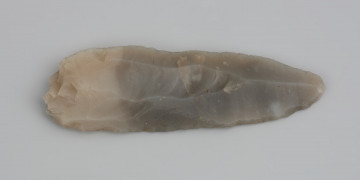
Perforator
9600 p.n.e. — 4100 p.n.e.
National Museum in Szczecin
Part of the collection: Bronze Age
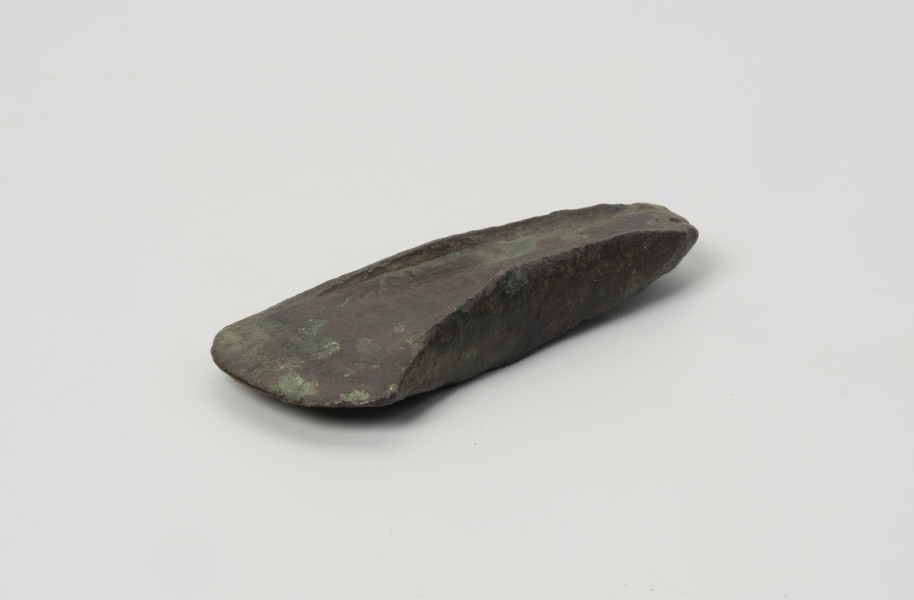
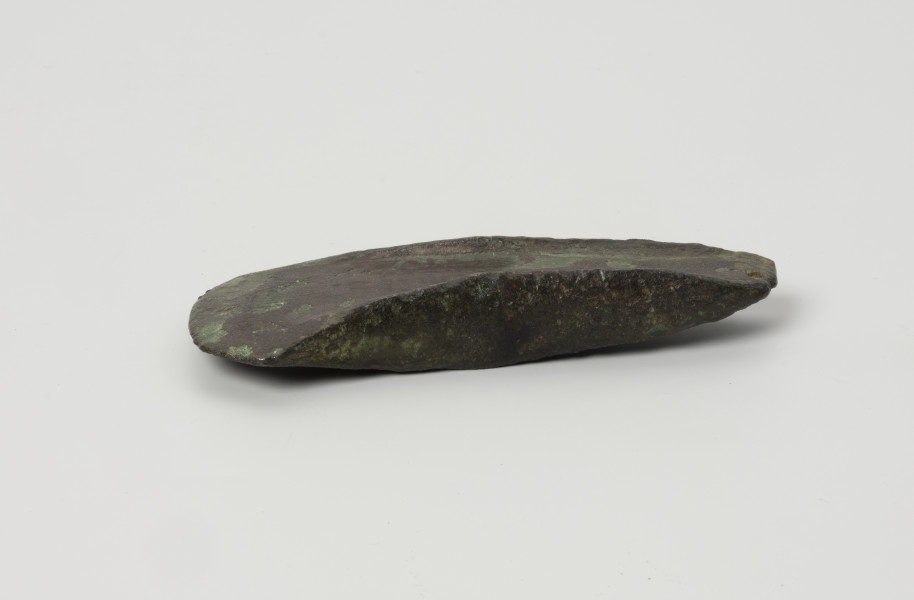
This heavily damaged artefact belongs to the category of axes with raised edges, meaning slightly elevated margins along both sides of the axe’s body. The visible surface losses and extensive patches are undoubtedly the result of the degradation processes that occurred over thousands of years while the object remained buried in the ground. However, the distinct deformation at the top of the butt, an indentation along the edge with a small hole beneath it—clearly resulted from the casting process rather than post-depositional damage. Archival records preserved in the Archaeology Department of the National Museum in Szczecin reveal only that the artefact was discovered by chance on land in the village of Niemica, near Kamień Pomorski. It was purchased for the museum collection in 1900 by the *Gesellschaft für Pommersche Geschichte und Altertumskunde* from a well-known antiquities dealer of the time, Henoch Flachs of Szczecin. Axes of this type from the early Bronze Age, specifically from the late phase of Period I and the first half of Period II of the Bronze Age (c. 1700–1500 BC), are classified in archaeological literature as the Grodnica type, variant B. So far, this type has only been recorded in Western Pomerania. It has appeared in several hoards discovered alongside other bronze objects in locations such as Domacyno, Łobez, Moryń, Smogolice, and Steklno. Dorota Kozłowska
Author / creator
Object type
axe
Technique
casting
Material
bronze
Origin / acquisition method
acquisition
Creation time / dating
Creation / finding place
Owner
The National Museum in Szczecin
Identification number
Location / status
9600 p.n.e. — 4100 p.n.e.
National Museum in Szczecin
11900 p.n.e. — 11000 p.n.e.
National Museum in Szczecin
11900 p.n.e. — 11000 p.n.e.
National Museum in Szczecin
DISCOVER this TOPIC
Museum of King Jan III's Palace at Wilanów
DISCOVER this PATH
Educational path