



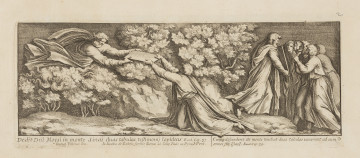
Dedit Dns Moysi in Monte Sinai duas tabulas testimonij lapideas | God gives the Tables of Law to Moses on Mount Sinai
1650 — 1670
National Museum in Szczecin
Part of the collection: Court art of Pomeranian dukes in 16th and 17th century
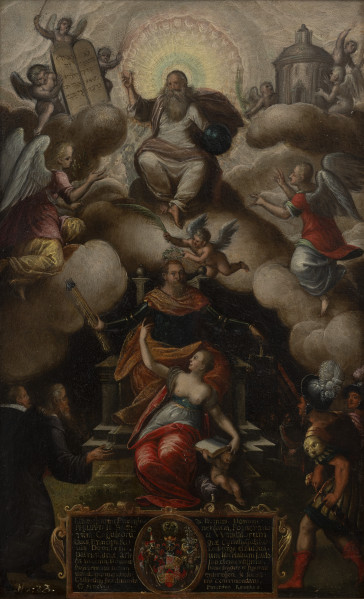
A small painting on a copper plate glorifying Duke Philip II (1573–1618), created in 1608. At the centre of the composition is the duke, seated on a throne and crowned with a laurel wreath by a putto hovering above him, holding a palm leaf – a symbol of victory. Towering over the scene is God the Father. In his hands, the ruler of Szczecin holds a set of scales, symbolising the justice of his rule, and a bundle of arrows, representing harmony between the dukes ruling Pomerania. This refers to the agreement on the division of power made by Philip II and his brothers following the death of their father, Bogusław XIII (1544–1606). At Philip's feet sits a female figure with a book, an allegory of wise governance. The duke is accompanied by scholars and soldiers. Above, in the heavenly realm, angels and putti are depicted on either side. Seated on clouds, they hold up the tablets of the Ten Commandments and a model of Solomon's Temple. Below the composition is an inscription plaque bearing the duke's titles and a dedication from the painting's creator. In the centre, within an oval, is the large coat of arms of Pomerania. Such representations glorifying rulers – known as apotheoses – became widespread in the 16th century. Often issued as prints for broad dissemination, they were also produced as paintings or sculptures and placed in public buildings or royal residences. Szczecin's apotheosis of Philip II was both a gift for the duke and a demonstration of the painter Pancratius Reinicke's skill. The artist, originally from Żary in Lower Lusatia, is recorded in Szczecin's municipal registers as a burgher between 1604 and 1610, the year of his death. The painting appeared in 1978 at the Heim Gallery auction house in London. Purchased by Poland's Ministry of Culture and Art, it entered the collection of the National Museum in Szczecin in 1979. Justyna Bądkowska
Author / creator
Object type
painting
Technique
oil technique
Material
copper plate
Origin / acquisition method
purchase
Creation time / dating
Creation / finding place
Owner
The National Museum in Szczecin
Identification number
Location / status
1650 — 1670
National Museum in Szczecin
1541
National Museum in Szczecin
2000 — 2001
National Museum in Szczecin
DISCOVER this TOPIC
Castle Museum in Łańcut
DISCOVER this PATH
Educational path