



The crossing of a Polish Fiat 508 Łazik car and a Sokół 1000 M111 solo motorcycle across the mountainous Dunajec River
20th century
Castle Museum in Łańcut
Part of the collection: Historia miasta i regionu
In the home garrisons, the brigade units trained soldiers intensively, especially as many reservists who reached a high level of proficiency in summer and autumn left after partial demobilisation.
The last combat mission of 10th Mounted Riflemen Regiment in 1938 was the occupation of Spiš; the regiment operated within the framework of the parent 10th Cavalry Brigade as a part of Operating Group “Podhale”. The photo DRM-1979/8 comes from that period. Immediately after the end of operations in Trans-Olza, an operational group was created based on 10th Brigade, whose task was to incorporate the region into Poland partially, including Jaworzyna Tatrzańska, Leśnica Pienińska and the surrounding areas. The three photos show the crossing of a Polish Fiat 508 Łazik car and a Sokół 1000 M111 solo motorcycle across the mountainous Dunajec River on the regiment's axis of operations; a makeshift ferry, made by the brigade's sappers, was used. The transported motorcycle was Sokół 1000 M 111 developed for the army by Eng. Tadeusz Rudowski in 1936. Those motorcycles came in two versions, i.e. solo and with a sidecar. The solo version was intended for messengers, officers and was used as liaison vehicles, whereas the version with the sidecar was used in reconnaissance units as support vehicles after fitting a light machine gun (rkm model 28 Browning) in the sidecar. At the same time, a special platform (instead of the sidecar) was developed to allow the installation of a heavy machine gun enabling, among other things, air defence fire. The design assumptions and price (around 4,200 Polish zloty) meant that most produced vehicles were sent to military units, where they became basic motorcycle equipment. Another transported vehicle was PF 508 111/W Łazik created in 1935 as an all-terrain passenger car being a development of the PF 508 III Junak civilian car. In the military version, the designers reduced the bodywork, in particular the side boards, to ensure fast getting in and out with long guns. The car had no permanent roof which was replaced with a tarpaulin for poor weather. The depleted body and lack of roof allowed firing in all directions without leaving the vehicle. The windscreen was foldable to facilitate forward firing. Inside the vehicle, gun mounts and grenade pouches were fitted. Some models had a vertical extension for mounting a hand-held Browning machine gun model 28. The RKM model 28 was developed in the first half of 1920s and its creation was necessitated by the use of several types of obsolete models on the one hand and the army's switch to 7.92 Mauser ammunition on the other. The beginnings of independence and the struggle for the borders were characterised by the variety of models of weapons, their ammunition, but also by the variety of close combat weapons and uniforms. It is easy to imagine that one unit could have had different types of light machine guns of different calibres and different ammunition that fitted only one model. This was due to the acquisition of arms and ammunition from the partition armies or of the weapons of French and allied design brought by the Blue Army. In such circumstances, logistics must have been a real challenge for the quartermaster services trying to keep the various divisions and formations in top fighting condition. The driving force behind the creation of new individual and team weapon models was the decision to standardise the calibre of the ammunition used to the 7.92 Mauser cartridge. Following numerous competitions, the Browning design was chosen (delivery of 10,000 weapons plus a licence for documentation to enable later production) manufactured at the FN plant. Since 1930, light machine guns (rkm) were produced at the Gun Factory in Warsaw where, by 1939, 13,000–14,000 guns were made, the price of which, with a toolbox and a set of spare parts, was 2060 zloty.
Przemysław Kucia
Object type
photography
Technique
photographic
Material
photographic paper
Creation time / dating
Owner
Muzeum - Zamek w Łańcucie
Identification number
20th century
Castle Museum in Łańcut

20th century, 1. połowa XX wieku
Castle Museum in Łańcut
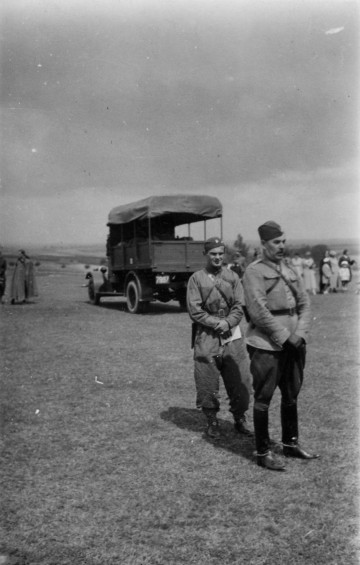
20th century
Castle Museum in Łańcut
DISCOVER this TOPIC
National Museum in Lublin
DISCOVER this PATH
Educational path