



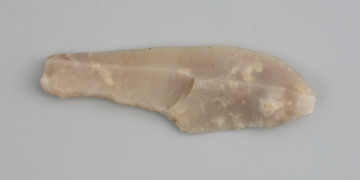
Single-jagged edge
11900 p.n.e. — 11000 p.n.e.
National Museum in Szczecin
Part of the collection: Stone Age
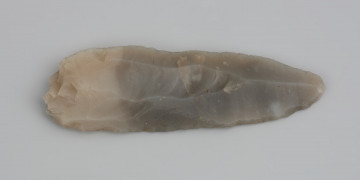
The unfinished leaf point found at the site of Szczecin-Śmierdnica 9 originates from amateur excavations carried out in the late 19th century. It was donated by Mr Dietert of Szczecin to the collection of the Gesellschaft für Pommersche Geschichte und Altertumskunde (Society for Pomeranian History and Antiquities). This collection was later transferred to the Provinzialmuseum Pommerscher Altertümer, which opened in 1927 and operated under the name Pommersches Landesmuseum in Stettin from 1934 until 1945. The object is a short flake in the shape of an elongated triangle, detached from a larger core using a soft hammer – likely made of antler. A key feature is the pattern of flake scars on the upper side, suggesting that the overall shape was preformed before the flake was struck. This method of working flint is known as predetermined debitage. The production of such flakes, which were then shaped into leaf points – used as spear, javelin or arrowheads – is characteristic of late Palaeolithic cultures. The Śmierdnica example lacks the retouching that would have formed a short tang, but based on its size, it was likely intended as a spearhead. The object can be linked to the Bromme culture, which existed in Western Pomerania during the second half of the Allerød period (around 11,500–10,800 BC). These were hunter-gatherer communities living in sparse birch and pine forests and settling near broad, marshy valleys. Their subsistence relied mainly on hunting elk and giant deer. The end of the Bromme culture came with climatic changes at the beginning of the Younger Dryas, which forced shifts in subsistence strategies and gradually led to the emergence of the Swiderian and Ahrensburgian cultures. Michał Adamczyk
Author / creator
Object type
semi-finished product, tanged point
Technique
soft-hammer knapping
Material
chalk flint
Origin / acquisition method
acquisition
Creation time / dating
Creation / finding place
Owner
The National Museum in Szczecin
Identification number
Location / status
11900 p.n.e. — 11000 p.n.e.
National Museum in Szczecin
11900 p.n.e. — 11000 p.n.e.
National Museum in Szczecin
9600 p.n.e. — 4100 p.n.e.
National Museum in Szczecin
DISCOVER this TOPIC
Museum of King Jan III's Palace at Wilanów
DISCOVER this PATH
Educational path