




The Family of Mary
circa 1505 — 1515
National Museum in Szczecin
Part of the collection: Medieval sculpture of West Pomerania
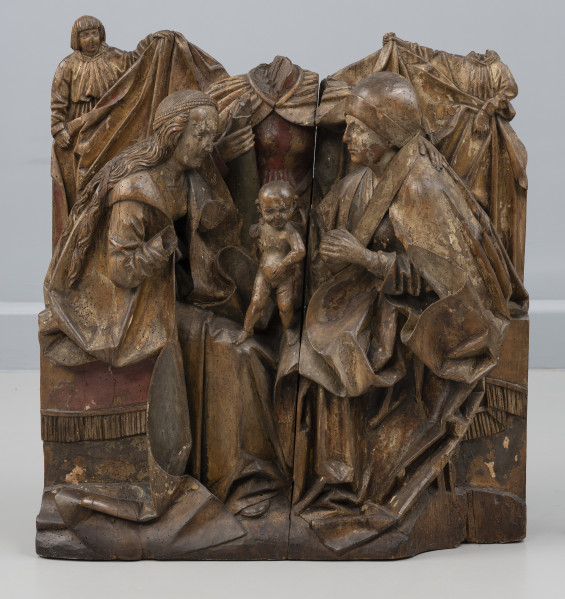
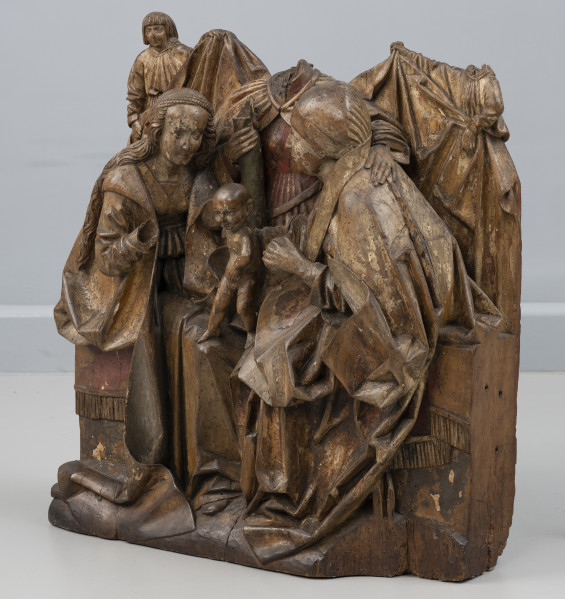
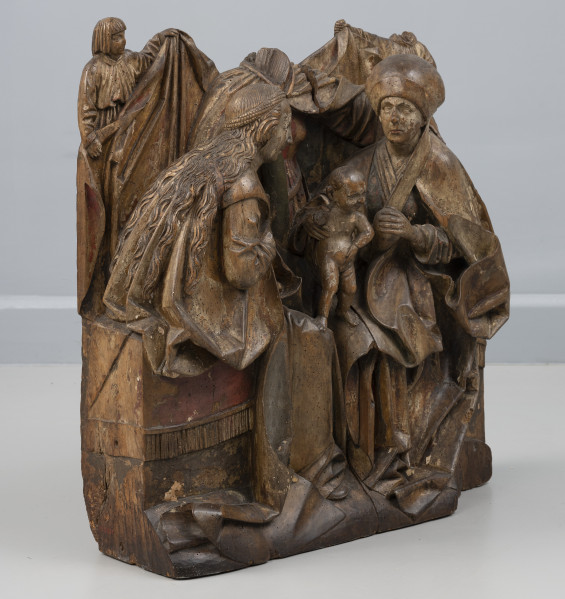
Emerentia is a name attributed in late medieval texts to Jesus’s great-grandmother. In Christian tradition, her figure complements the genealogy of Mary of Nazareth, similarly to Saint Anne. In art, depictions of Saint Anne with the Virgin Mary and the Christ Child that include a fourth figure, Emerentia, are referred to as “Samoczwarć in Polish, meaning four together.
The sculptural group from Altwigshagen represents a pyramidal composition characteristic of German art from the early 16th century to the 1530s. Despite damage to the upper part of the sculpture, the figure of Emerentia clearly dominates over the seated figures of Mary and Anne, who hold the Christ Child. Emerentia’s central position and protective gesture of embracing her daughter highlight her role as a guardian. In her right hand, she presumably holds a fragment of her attribute, a triple-branched tree trunk symbolising growth, fruitfulness, fertility, and motherhood.
This motif originates from a prophetic vision that occurred 77 years before the birth of Jesus on Mount Carmel, as documented in the Vita gloriosissime matris Anne, published in Paris in 1502. According to the vision, a hermit saw a root from which two trees grew; one of these trees had three branches, one of which was exceptionally lush. A voice accompanying the vision proclaimed that the root represented Emerentia, a pious woman visiting Mount Carmel, who was destined to have exceptional offspring. The three-branched tree symbolises Saint Anne and her three daughters, including the most significant, Mary, the mother of Jesus.
The sculpture of Emerentia was discovered in the attic of the church in Altwigshagen and was transferred to the Szczecin museum in 1935 or 1936. Designed as a wall-mounted piece, it likely originally formed part of an altar, possibly in its central section. The sculpture’s distinctive style, unusual for Pomeranian art, has stylistic analogies with works by Jörg Lederer, Daniel Mauch, and Hans Thoman, suggesting its origin in the Swabian region and dating it to around 1515–1520. The commission or import of the sculpture to Pomerania is attributed to the von Borcke family, former owners of the village of Altwigshagen.
The sculpture is displayed in the permanent exhibition The Mystery of Light: Medieval Art in Pomerania.
Kinga Krasnodębska
Author / creator
Object type
sculpture, sacred object, altar element
Technique
sculpture, polychrome
Material
poplar wood, paint
Origin / acquisition method
acquisition
Creation time / dating
Creation / finding place
Owner
The National Museum in Szczecin
Identification number
Location / status
circa 1505 — 1515
National Museum in Szczecin
circa 1520 — 1530
National Museum in Szczecin
circa 1430
National Museum in Szczecin
DISCOVER this TOPIC
National Museum in Szczecin
DISCOVER this PATH
Educational path