




Execution
1893 — 1900
National Museum in Szczecin
Part of the collection: From the history of non-European expeditions
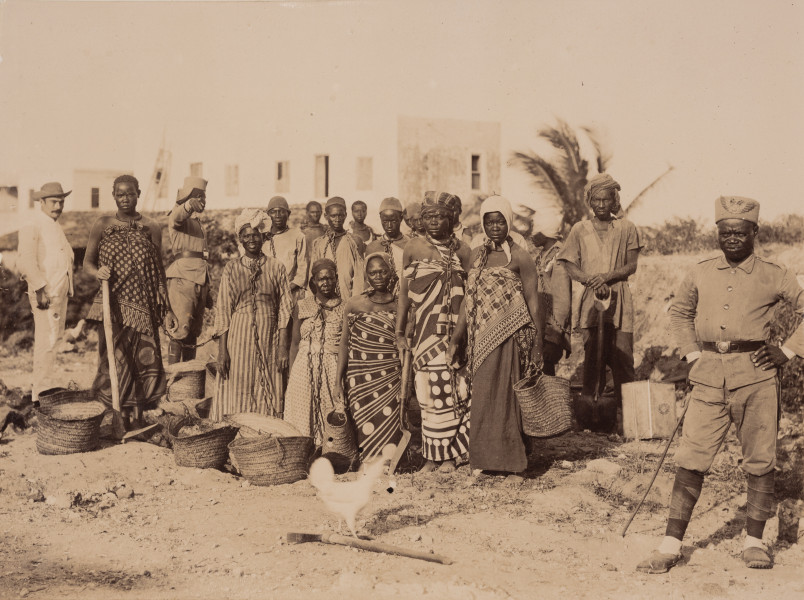
Aleksander Dandelski (1863–1944) was a Prussian officer who, at the end of the 19th century, served in German East Africa, a colony in the area of Tanganyika (East Africa). The photograph presented here was probably taken there in 1893. The photo depicts enslaved local people working against the backdrop of colonial buildings. The slaves are standing close together, chained with metal collars around their necks. They are accompanied by a man dressed in white, wearing a hat characteristic of the Schutztruppe – the German colonial troops – and two Askari soldiers, native troops in the German African army. One of the Askari is pointing at the camera and the photographer. Most of the enslaved people have serious expressions on their faces, except for a woman dressed in a striped dress, who seems to be smiling at the camera. Some of them are standing in a dug pit and are holding shovels and pickaxes. In front of them are woven local storage baskets filled with sand, clay, and stones. It seems they were forced to dig, perhaps carrying out fieldwork or building a railway. Photographs of slaves in German colonies from that period were often described as images of prisoners or convicts. Officially, the German Empire had occupied territories in the African Great Lakes region, in part to combat slavery and the slave trade, a stance they had adopted since 1885. However, in practice, slavery was never abolished there because the real colonial policy of Berlin was focused on ruthlessly extracting financial benefits from the resources of the conquered region. The local population was displaced, exploited through taxes, and forced to work in mines, on plantations, building railways, or transporting goods. Only after World War I, when the territories of Tanganyika, occupied by Great Britain, were granted mandate status in 1922, was slavery abolished there. Katarzyna Findlik-Gawron
Author / creator
Object type
photograph
Technique
photography, sepia toning
Material
photographic print paper, cardboard, leather
Origin / acquisition method
donation
Creation time / dating
Creation / finding place
Owner
The National Museum in Szczecin
Identification number
Location / status
1893 — 1900
National Museum in Szczecin
1893 — 1900
National Museum in Szczecin
1893 — 1900
National Museum in Szczecin
DISCOVER this TOPIC
National Museum in Lublin
DISCOVER this PATH
Educational path