

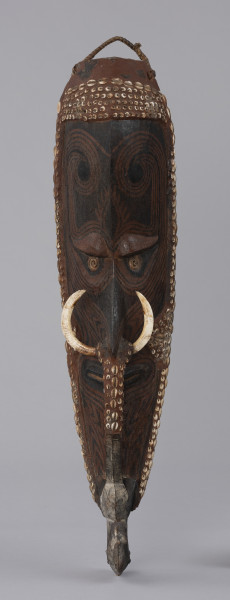


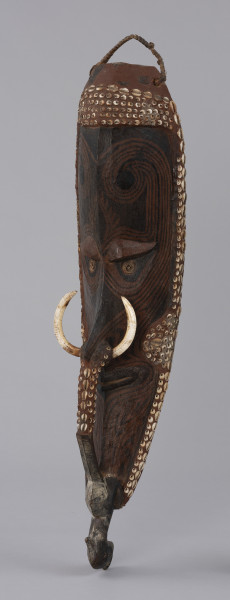
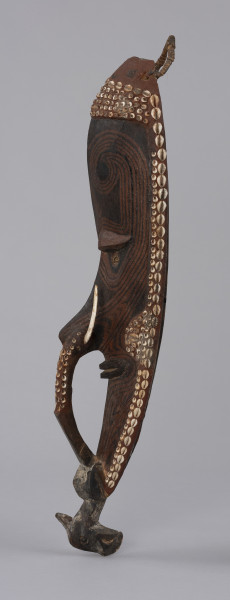
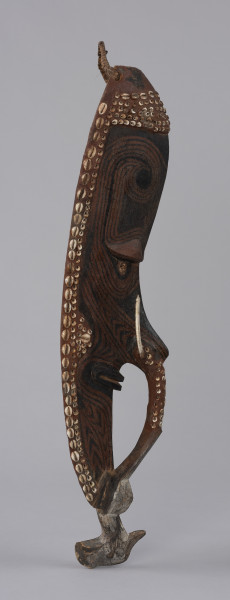
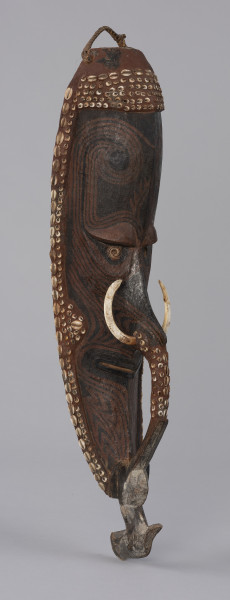
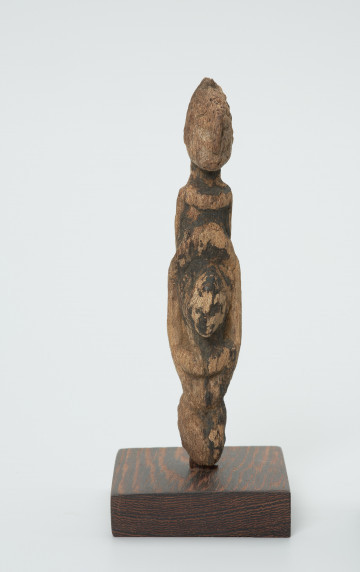
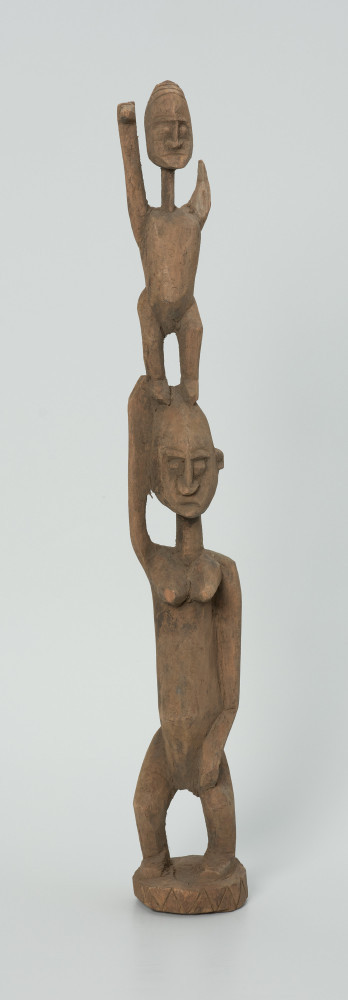
Figurine -Dyon carrying Arou
między 1901 — 1950
National Museum in Szczecin
Part of the collection: Art of Papua New Guinea
The origin of mai masks is associated with a legend telling of the ancestors of Iatmul who wanted to appropriate the power of foreign dancers hidden in their performances and strong voices resounding through bamboo tubes also called mai. Once upon a time, the warriors of Iatmul travelled north, to a place from which mysterious sounds were heard. They captured the dancers and led them to their village. To which they said: "you can let us go, we will perform for you". The Iatmul watched and imitated the performance of the men until they took over the singing of the two mai. Meanwhile, in the village, the two brothers Malimali and Yambuge had two sisters, Yambugendshoa and Malindshoa. Today the Iatmul during singsing (festival) do as these four ancestors danced, and carve mai in pairs to depict male and female supernatural siblings – two brothers and two sisters.
It is a mask characteristic of the western Iatmul group, speaking the Nyaula dialect. It has a typical mai arched handle called a molot, which takes the form of a clay and wooden arch starting below the nostrils and ending under the chin carved with a bird's head. During the ceremonial dance, young men and boys wore mai, covering the face and upper body, into large, braided, frame-like costumes, decorated with leaves, feathers and shells. The dancers perform on a platform with a background depicting the mountains of Alexander, where Iatmul believes that mai come from. After the performance, they are kept in the men's house, where they are also made. Iatmul believe that mai are the embodiment of the presence of ancestors, and their creation is understood as growth. It is not so much the actual male relative-sculptor who participates in it, but the ancestors, who fill the mask with spirituality, without which mai would be just a piece of wood. Regulated by many rules and actions, the six-week process ends only with the first performance, allowing masks to speak, while they become full-fledged individuals.
Katarzyna Findlik-Gawron
Other names
mai; mwai; mei; mwei
Author / creator
Object type
sculpture, cult object, dance mask, ceremonial mask
Technique
sculpture, painting, weaving (basketry)
Material
wood, clay, cowrie shell, nassa shell, pig tusk, natural dye, plant fiber
Origin / acquisition method
purchase
Creation time / dating
Creation / finding place
Owner
The National Museum in Szczecin
Identification number
Location / status
między 1901 — 1950
National Museum in Szczecin
między 1951 — 2000
National Museum in Szczecin
między 1976 — 1984
National Museum in Szczecin
DISCOVER this TOPIC
Castle Museum in Łańcut
DISCOVER this PATH
Educational path