




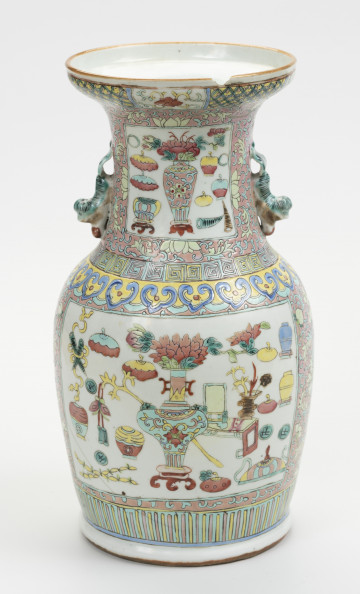
Famille rose vase
1751 — 1900
National Museum in Szczecin
Part of the collection: Asian art
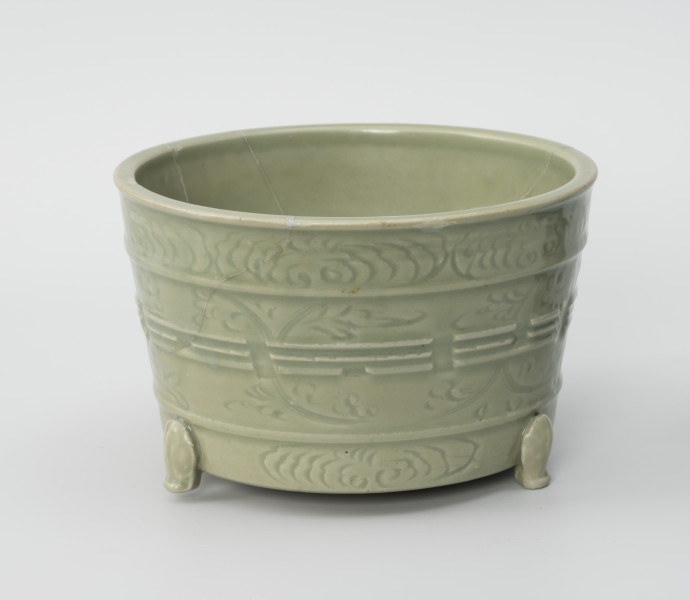
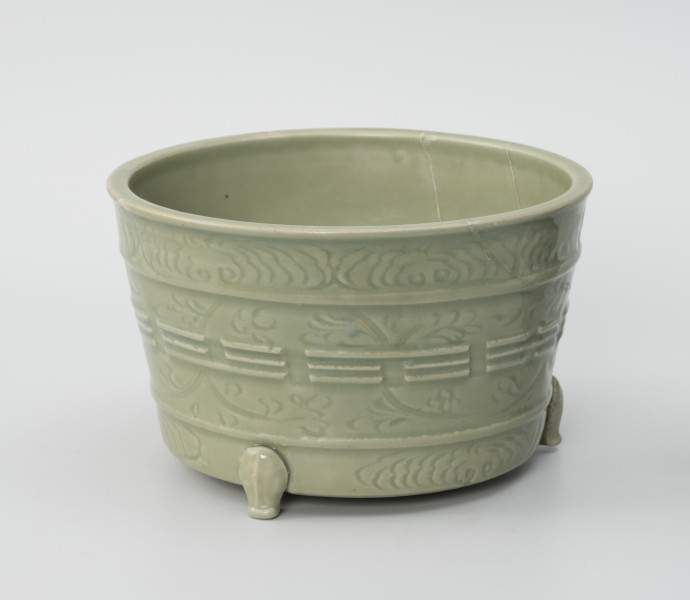
Celadon refers to both a type of Chinese ceramic and the distinctive glaze characteristic of it, which includes an iron oxide component that gives the pieces a light green, olive, or greyish-green colour. It has been known in China since at least the 7th–8th centuries and was exported to regions of East Asia and the Islamic world from early on. The stoneware flowerpot presented here, covered in celadon glaze, was made during the late Ming Dynasty (1368–1644), specifically in the 16th century. It is adorned with a relief decoration in three sections, divided by two surrounding bands and rests on three small animal-paw-shaped legs. The upper and lower bands of decoration feature what are likely peony motifs, a popular theme in Chinese culture, depicted as large, fully bloomed flowers. In the central part, the design takes the form of young stems, leaves, and flowers of the same plant, arranged with raised lines in various sequences, representing the bāguà – eight trigrams from the Yijing (Book of Changes). The Book of Changes is one of the oldest Chinese cosmological and philosophical texts, foundational for both Taoism and Confucianism. The origin of the eight ancient divinatory trigrams is linked to the legendary ruler Fuxi from the 3rd millennium BCE, who is said to have observed these symbols when contemplating the patterns on a turtle shell. Each trigram (gua) consists of three lines: broken ones symbolising yin or unbroken ones symbolising yang. Later interpreters associated each symbol with specific elements of nature, traits of the mind, personality, cardinal directions, or family roles – forming the basis of a philosophical and divinatory system with universal applications. Trigrams were often placed on military and religious leaders' attire, worn as talismans, and frequently appeared in the ornamentation of Chinese ceramics. Katarzyna Findlik-Gawron
Author / creator
Object type
vessel (container)
Technique
throwing (pottery technique), glazing
Material
stoneware, celadon
Origin / acquisition method
acquisition
Creation time / dating
Creation / finding place
Owner
The National Museum in Szczecin
Identification number
Location / status
1751 — 1900
National Museum in Szczecin
1801 — 1910
National Museum in Szczecin
618 — 907
National Museum in Szczecin
DISCOVER this TOPIC
National Museum in Szczecin
DISCOVER this PATH
Educational path