



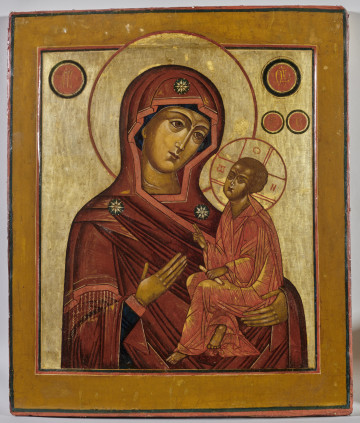
The Mother of God Odigitria [The Mother of God Odigitria of Tikhvin]
2nd half of the 19th century
Castle Museum in Łańcut
Part of the collection: Ikony
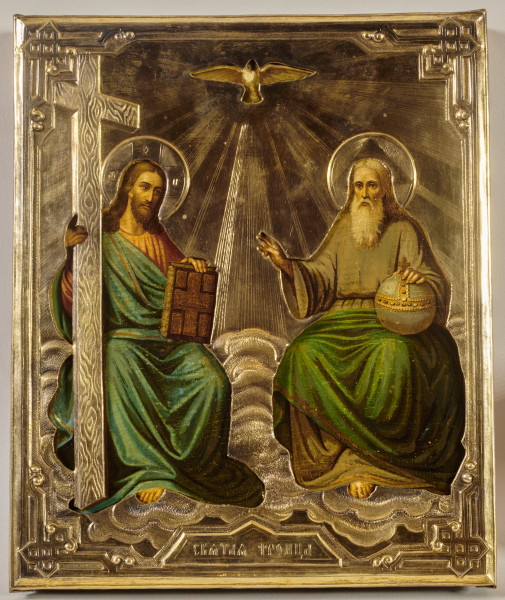
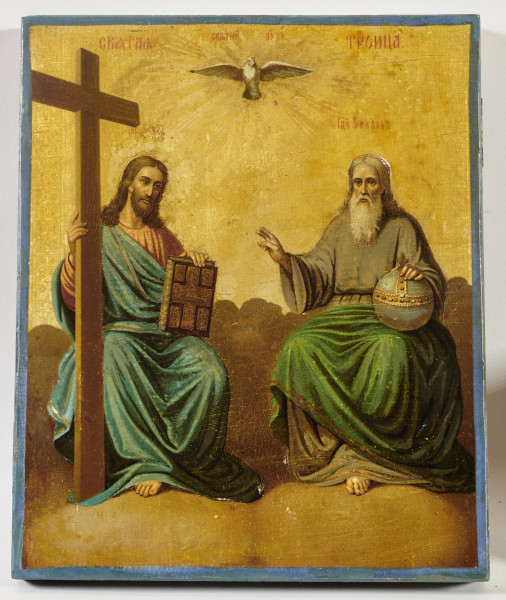
The exhibited icon belongs to the non-canonical variants of the so-called New Testament Trinity. In Russian Orthodox Church, such presentation is referred to as “Co-Enthroned”. The image shows the Holy Trinity in the figures of God the Father, God Son and the Holy Spirit hovering above them as a dove. Icons of this type appeared in Eastern Christianity in 14th century under the influence of Western European art and spread to Byzantium and the Balkans. Within the Moscow Orthodox Church, the oldest known icon dates back to 16th century (the Annunciation Cathedral in the Moscow Kremlin). The permissibility of imaging the invisible Father and the Holy Spirit was established by the Moscow Orthodox Church Council in 1553–1554. The justification for the image became the Book of Daniel. In his prophetic vision, Daniel saw the Eternal Old Man (Dan 7:3-14). The Council explained that painters do not show the essence of the Invisible God, but only the figure in which He revealed Himself in the Old Testament. However, a century later, the Great Moscow Council completely banned any images of the New Testament Trinity in 1667. Reference was made to the text of John the Evangelist who wrote that the incorporeal and invisible God the Father (John 1:18) was revealed to us only in the person of the Son of God. For this reason, God the Father can be depicted solely symbolically. The most appropriate form of this type of representation is the depiction of the Holy Trinity in the form of the Son of God Incarnate and therefore visible (the Old Testament Trinity, e.g. Rublev's famous icon). The Holy Synod of the Constantinopolitan Church did not declare a ban on non-canonical variants of the image until 1776. Despite the bans, icons of the New Testament Trinity continued to appear in Eastern Christianity.
Teresa Bagińska-Żurawska https://orcid.org/0000-0002-9243-3967
Author / creator
Object type
ikony
Technique
olej, pozłotnictwo, metaloplastyka, stolarskie
Material
wood, chalk, gold, brass, glass
Creation time / dating
Creation / finding place
Owner
Muzeum - Zamek w Łańcucie
Identification number
Location / status
2nd half of the 19th century
Castle Museum in Łańcut
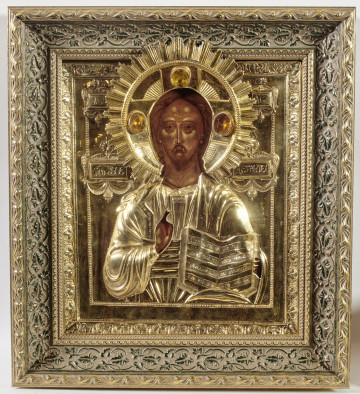
XIX century
Castle Museum in Łańcut
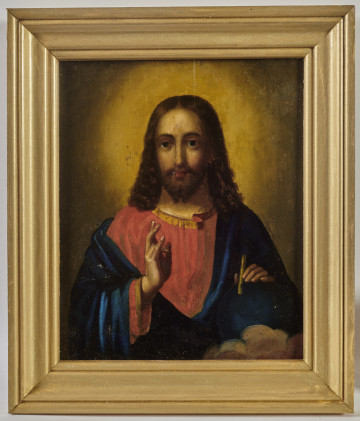
2nd half of the 19th century
Castle Museum in Łańcut
DISCOVER this TOPIC
Museum of King Jan III's Palace at Wilanów
DISCOVER this PATH
Educational path