


Polelum
1962
National Museum in Szczecin
Part of the collection: European classics of modernity
During the inter-war period, the Pan-Slavic movement developed exuberantly. While in the first decade the alliances of Poland and Czechoslovakia were clear, in the following decade the culture of the Kingdom of Yugoslavia was of greater interest. In 1937, the Croatian Antun Augustinčić (1900-1979) won a competition for a statue of Józef Piłsudski in Katowice, and in 1939 his compatriot Ivan Meštrović (1883-1962) presented his vision for a similar monument in Warsaw.
After the end of the Second World War, the establishment of individual contacts was restricted from 1949 by Stalinism, resulting in the sealing of the borders of the communist states and the separation, independent of the USSR, of the Socialist Federal Republic of Yugoslavia. Only the Polish October in 1956 (also known as the Polish thaw) slowly opened the borders again. Although initially travel was only possible as part of organised Orbis tours, from 1977 onwards travel in the countries of the People's Democracy was possible without a passport.
For Sławomir Lewińsky, the opportunity to visit southern Europe was of particular importance. At the threshold of his artistic education, he observed the activities of Yugoslav sculptors, and was also introduced to their work by his master, Serbian Jan Dymicz (1877-1945). From his many trips to Yugoslavia, and later also to Bulgaria, Greece and Italy, the Szczecinian brought back drawings of pre-war statues, admiration for monuments of antiquity and inspiration from Renaissance art. As a result, he subjected his forms to modernisation, folkloric styling and sometimes took over from classical art the smoothness of the surface and the precision of the contour.
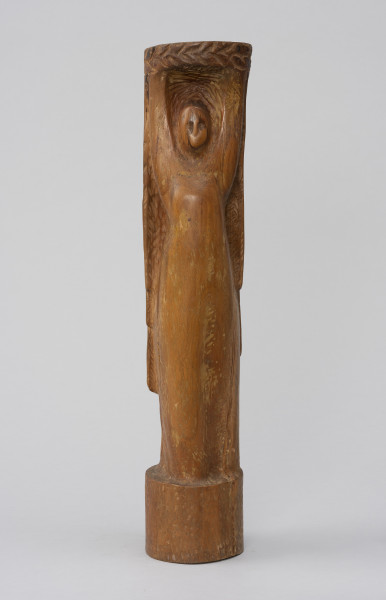
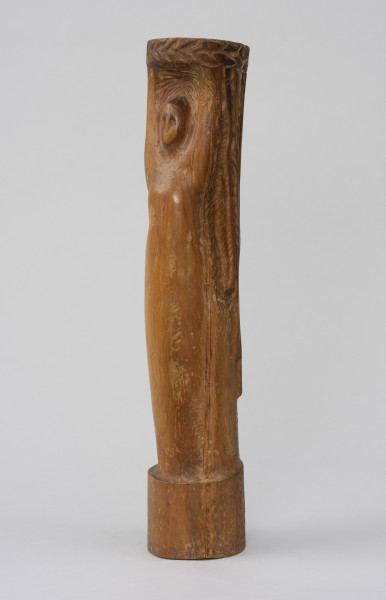
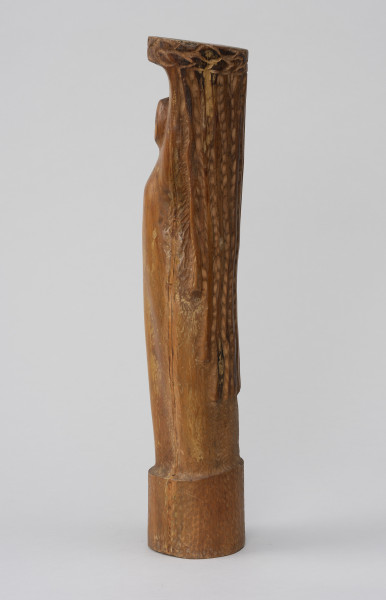
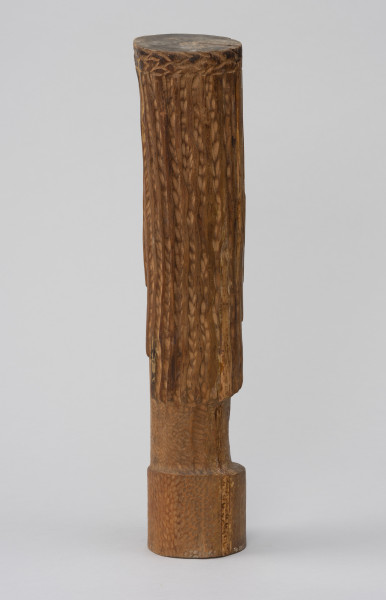
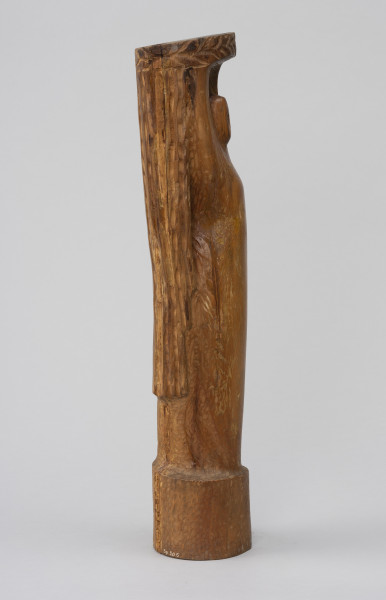
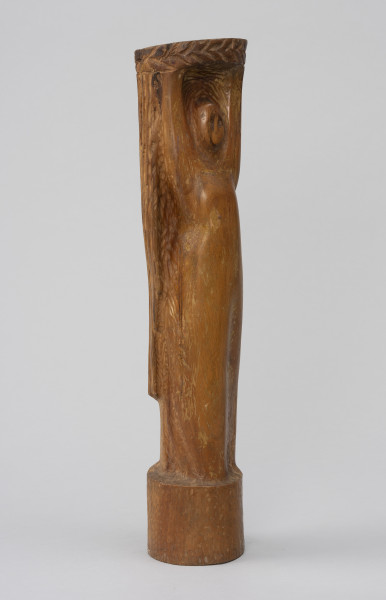
In the presented wooden statue of a woman whose head is crowned with a harvest wreath, one can see reminiscences of Lewińsky's encounter with the Tomb of the Unknown Soldier on Belgrade's Mount Avala by Meštrović (1938) – with realistic caryatids in folk costumes guarding the entrance.
Szymon Piotr Kubiak
Author / creator
Object type
sculpture
Technique
woodcarving techniques
Material
wood
Origin / acquisition method
legal transfer
Creation time / dating
Creation / finding place
Owner
The National Museum in Szczecin
Identification number
Location / status
1962
National Museum in Szczecin

1962
National Museum in Szczecin

between 1957 — 1963
National Museum in Szczecin
DISCOVER this TOPIC
National Museum in Lublin
DISCOVER this PATH
Educational path