



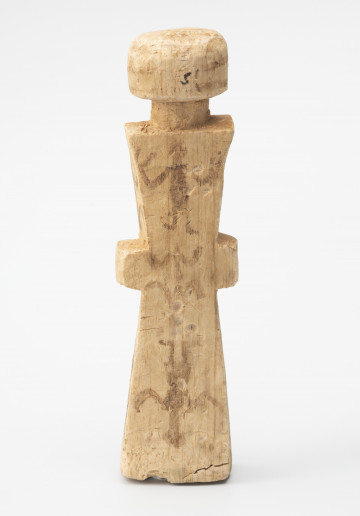
Magical figurine
circa 1960 — 1970
National Museum in Szczecin
Part of the collection: Indigenous Latin American Communities Crafts
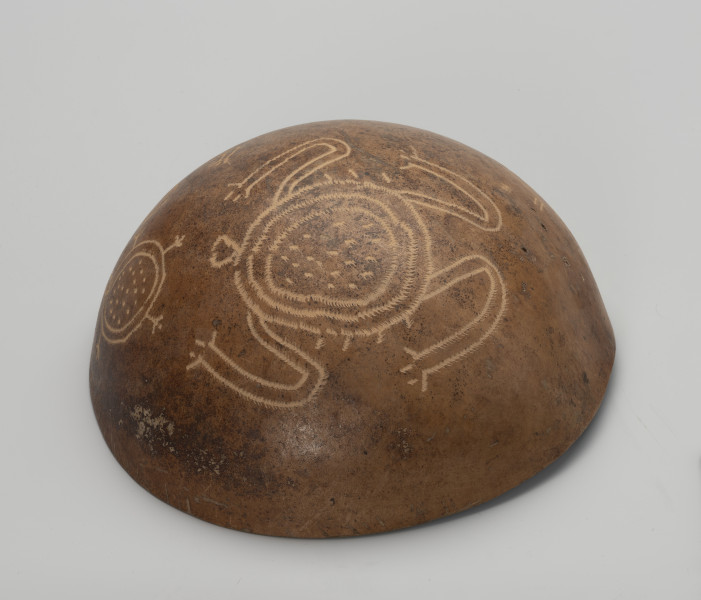
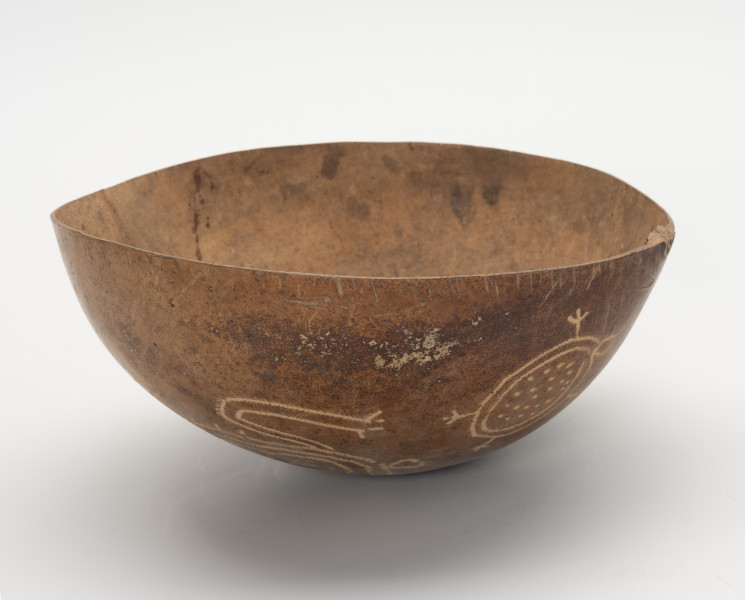
Many South Americans use gourds, i.e. woody and thick pericarps of some bignonia and cucurbitaceae plants, also known as calebas as everyday objects and musical instruments. The bowl on display is made from the halved fruit of the Calabash tree (Crescentia cujete), grown near the settlements of the Noanamá group (Waunana), inhabiting the San Juan basin, a river flowing into the Pacific Ocean, flowing through the Chocó department in western Colombia. Such vessels are used to serve food and drinks there, including those commonly sipped during feasts, such as guarapo – a fermented drink made from sugar cane juice.
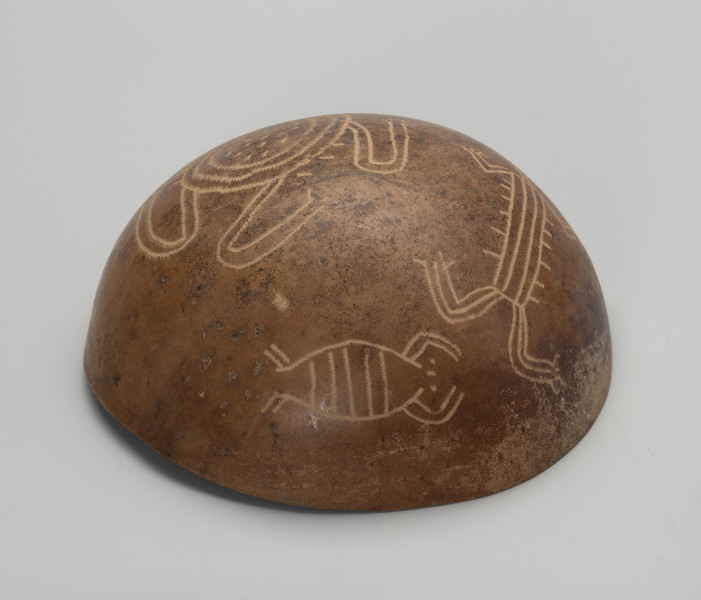
Calabash are collected by men who cut them to the right shape and size, then use a knife to hollow out the white flesh, smooth the inside and leave it to dry for a few weeks. When they are dry, they are decorated by women. The ornamentation, typical of the Noanamá group, is made with a small metal tool, traces of which in the form of shallow and small cuts are visible on the engraved drawings. The patterns depicted on the dishes are primarily geometric and zoomorphic motifs: figures of crayfish, turtles, frogs, lizards, birds; Anthropomorphic drawings are less common.
In addition to the human figure, the bowl is most likely also engraved with a pattern of a land turtle accompanied by a smaller tortoise and a crayfish, which often appears in Noanamá's art. Inside the object there is an inscription "Noanama" – a marking made by Boris Malkin, an anthropologist who conducted field research among Noanamá in the years 1968–1972, from which he obtained the presented gourd.
Katarzyna Findlik-Gawron
Author / creator
Object type
bowl, calabash (vessel)
Technique
cutting, curving (engraving)
Material
calabash
Origin / acquisition method
purchase
Creation time / dating
Creation / finding place
Owner
The National Museum in Szczecin
Identification number
Location / status
circa 1960 — 1970
National Museum in Szczecin

1900 — 1945
National Museum in Szczecin

1850 — 1900
National Museum in Szczecin
DISCOVER this TOPIC
Castle Museum in Łańcut
DISCOVER this PATH
Educational path