




Wadżra
1901 — 1984
National Museum in Szczecin
Part of the collection: Asian art
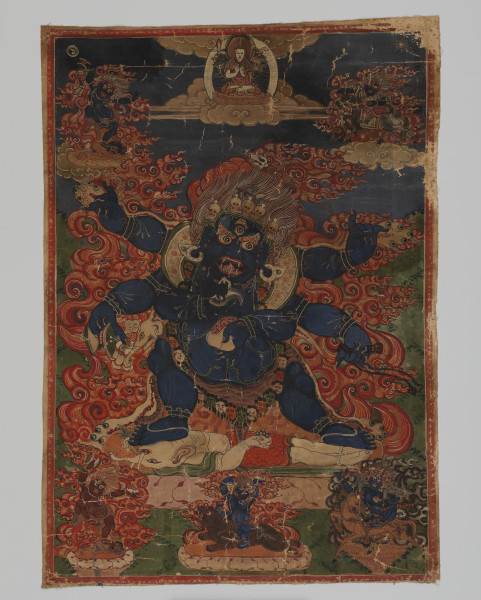
The six-armed, blue figure set against a fiery mandala at the centre of the thangka presented here is Mahākāla (Great Time, The Devourer of All), regarded as the wrathful manifestation of Avalokiteśvara – the bodhisattva of compassion and mercy. In Tibetan Buddhism, he is the most powerful of the dharmapālas (Sanskrit: protectors of the Dharma), whose fearsome appearance is meant to ward off enemies of the faith. He is depicted with numerous attributes. The crown of five skulls (Sanskrit: pancakapala) represents the transformation of the five negative emotions of human nature – anger, greed, envy, ignorance, and pride – into five wisdoms. The long garland of severed human heads (Sanskrit: muṇḍamālā, kapālamala), which reaches down to his ankles, symbolises Mahākāla's ability to overcome all obstacles on the path to enlightenment. In his hands, he holds various objects of symbolic significance. A circular rosary made of skulls and a trident in the two upper hands represent his destructive and ascetic aspects. In his middle hands, he holds a ceremonial drum (damaru) and a supernatural weapon: a noose used to bind negative forces. In his lower hands, Mahākāla holds a small crescent-shaped hand knife (kartika) and a skull cup (kapala) filled with human organs, symbolising the impermanence of the human body and life. The standing figure of the wrathful Avalokiteśvara tramples the body of the elephant-headed Ganesha, who, both in Buddhism and Hinduism, is known for removing obstacles from the path to enlightenment. However, in this case, he personifies the difficulties encountered along that path. Surrounding the central figures are five smaller characters resembling Mahākāla. In the clouds above them, towering over the others, is a teacher from the Nyingma school – the oldest school of Buddhism in Tibet. Katarzyna Findlik-Gawron
Author / creator
Object type
painting, sacred object
Technique
tempera
Material
cotton canvas, silk, wood, tempera
Origin / acquisition method
purchase
Creation time / dating
Creation / finding place
Owner
The National Museum in Szczecin
Identification number
Location / status
1901 — 1984
National Museum in Szczecin

1801 — 1900
National Museum in Szczecin

1901 — 1950
National Museum in Szczecin
DISCOVER this TOPIC
Museum of King Jan III's Palace at Wilanów
DISCOVER this PATH
Educational path